Battery internal resistance
A real battery is an ideal voltage E in series with a small internal resistance r. With no load you read E. Under load, I · r is lost inside, so the terminal voltage sags and the battery warms up.
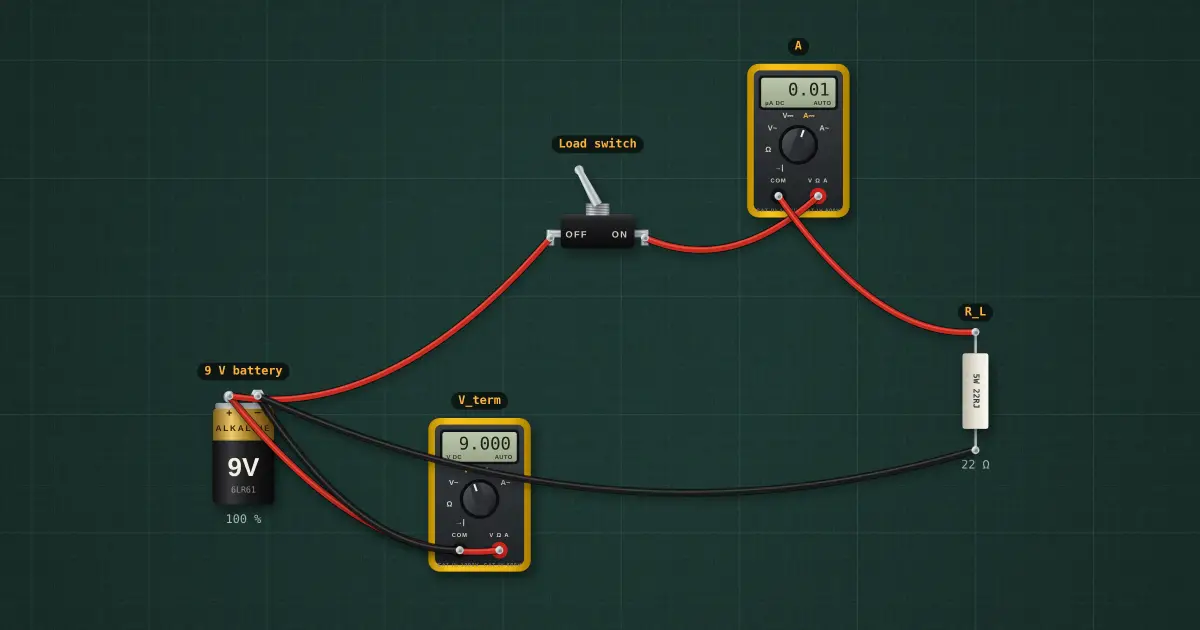
Open this lesson in the labFree, in your browser, no account needed.
How it works
E = 9 V, r ≈ 1.5 Ω (a fresh alkaline PP3)
I = E / (r + RL) = 9 / (1.5 + 22 Ω) = 382.2 mA
Vterminal = E − I·r = 8.427 V; lost inside: I²·r = 219 mW
Measure it yourself: r = (Vopen − Vloaded) / I. The short-circuit current is E / r = 6 A, which is why a 9 V battery can’t start a car.
Try it on the bench
- Close the load switch and watch V_term drop from 9 V.
- Change R_L to 4.7 Ω: the sag gets much worse. Low-resistance loads expose the internal resistance.
- Compare with the bench supply, which has about 0.02 Ω inside.
Parts on the bench
- 9 V battery
- 2 × Digital multimeter
- Toggle switch
- Resistor
In the course
Zen’s Electronics Design Mastery, module “DC Fundamentals”.