Cells in series and parallel (LiFePO4)
Cells in series add their voltages (and their internal resistances). Cells in parallel keep the same voltage but share the current, halving the internal resistance and doubling the capacity. Battery packs combine both: 4S2P means 4 in series, 2 in parallel. Only rechargeable cells of the same type and charge go in parallel; a non-rechargeable cell must never be paralleled or charged.
Open this lesson in the labFree, in your browser, no account needed.
How it works
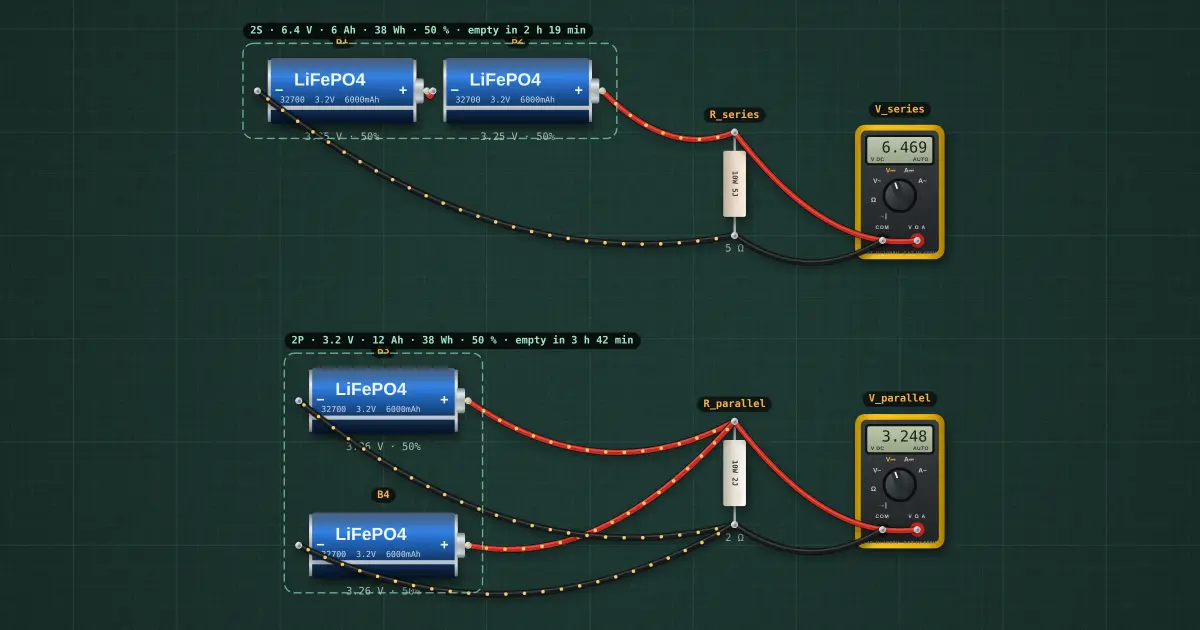
Series: E = 3.28 + 3.28 = 6.56 V, r = 0.02 + 0.02 = 0.04 Ω → V = 6.56 × 5 Ω / (5 Ω + 0.04) = 6.469 V
Parallel: E = 3.28 V, r = 0.02 / 2 = 0.01 Ω → V = 3.248 V, and each cell supplies half of 1.624 A.
Capacity: two 6 Ah LiFePO4 cells in series give 6.4 V at 6 Ah; in parallel they give 3.2 V at 12 Ah. Same energy either way (38 Wh). Four in series is the 12.8 V battery of a solar system; four in series and two in parallel (4S2P) is a 12 Ah one.
The measured sag also includes about 10 mΩ per hook-up wire, which matters at these low resistances.
Rechargeable cells only. Alkaline and other non-rechargeable cells are never put in parallel and never connected to a charger: the fuller one pushes current into the emptier one, which heats, leaks or ruptures. Packs are built from LiFePO4, Li-ion or NiMH cells of one type, one age and one state of charge.
Try it on the bench
- Flip B2 around (select it, press R twice): the two cells now cancel and the series string gives about 0 V.
- Set B4 to 90 % and B3 to 20 % (select each, drag the charge): B4 now pushes current into B3 even with no load. This is why cells are matched before paralleling.
- Lower R_series to 1 Ω (10 W): the series string sags more, because its internal resistance is four times that of the parallel pair.
Parts on the bench
- 4 × LiFePO4 cell
- 2 × Resistor
- 2 × Digital multimeter
In the course
Zen’s Electronics Design Mastery, module “DC Fundamentals”.