Capacitor discharging
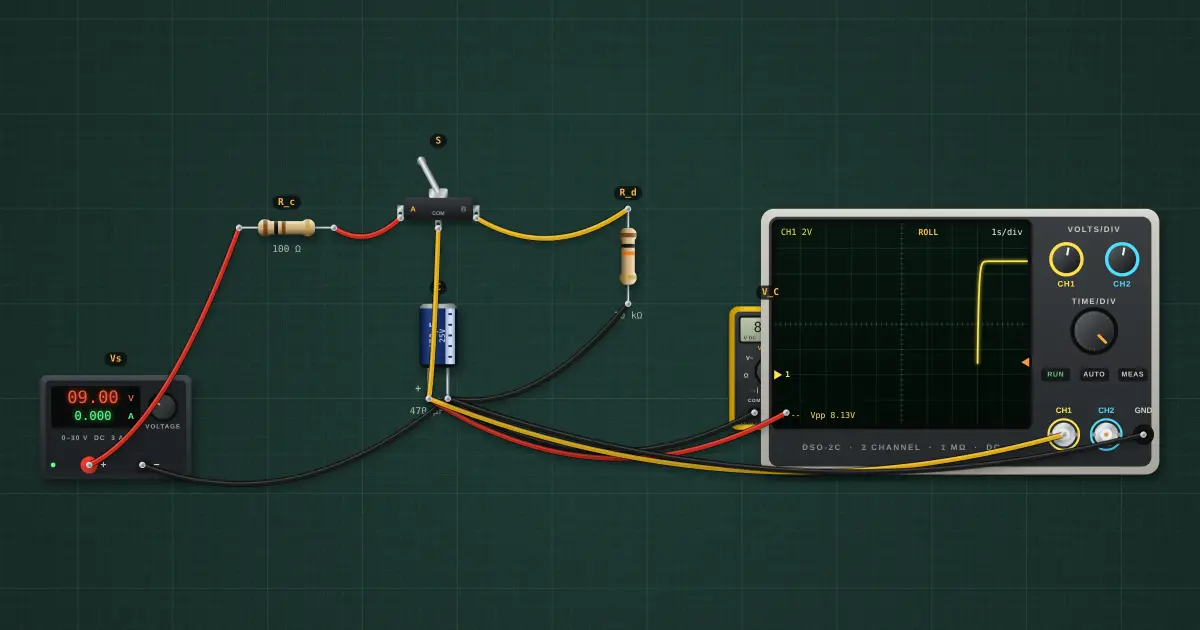
A charged capacitor emptying through a resistor decays exponentially toward zero. It loses 63 % of its voltage every time constant.
Open this lesson in the labFree, in your browser, no account needed.
How it works
τ = Rd · C = 4.7 s
VC(t) = V0 · e−t/τ, I(t) = (V0 / Rd) · e−t/τ
After 1τ: 36.8 % left. After 5τ: 0.7 % left. The scope’s 1 MΩ input sits in parallel with Rd, so the bench decays about 1 % faster.
Try it on the bench
- Click the changeover switch S to B. The capacitor discharges through R_d.
- Click it back to A to recharge in a fraction of a second through the 100 Ω resistor.
Parts on the bench
- Bench power supply
- 2 × Resistor
- Changeover switch
- Electrolytic capacitor
- Digital multimeter
- Oscilloscope
In the course
Zen’s Electronics Design Mastery, module “Capacitors, Inductors & Time”.