1 HP inverter aircon on a 3.6 kW hybrid at night: what the battery sees
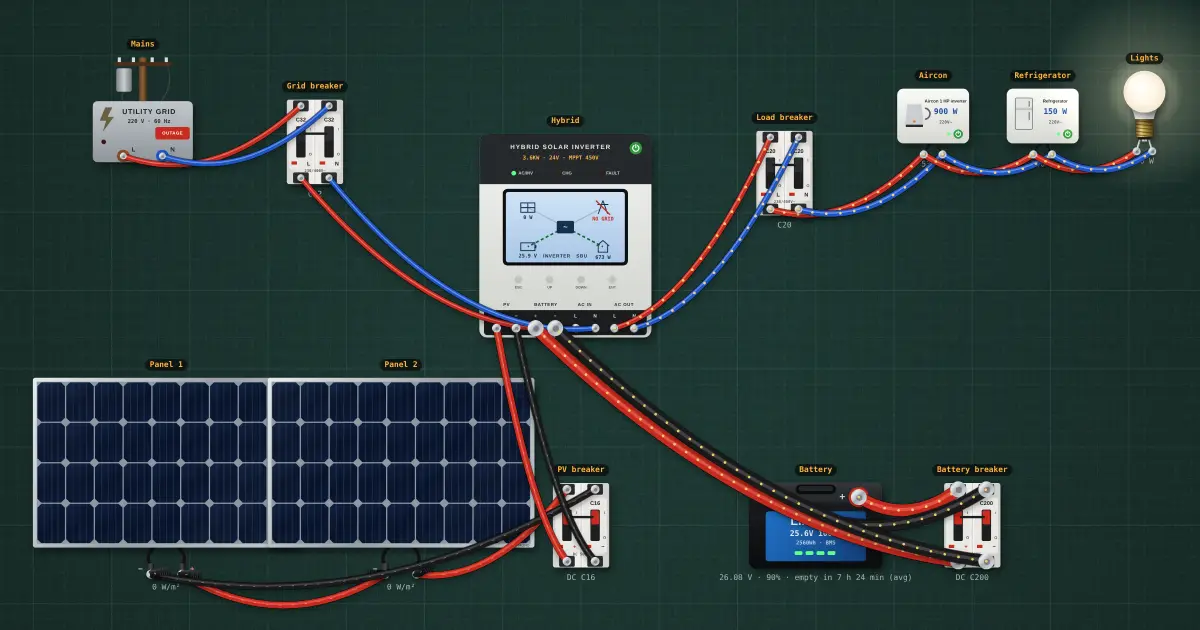
Night-time: no sun, a 24 V 100 Ah LiFePO4 battery feeding a 3.6 kW hybrid, a 1 HP inverter aircon, a refrigerator and lights. The panel shows battery current and the hours left. The question every solar quote gets asked: will it run the aircon at night? It depends on the battery, not the panels. A 1 HP inverter aircon draws about 900 W while the room cools, then settles near 500 W; through the inverter that is 20 to 40 A out of a 24 V battery. The bench shows the battery current, the hours left, and what happens when a non-inverter aircon is added instead.
Build it in the labGuided build, test sheet and fault finding, free in your browser.
Parts list
- Utility grid
- 2 × AC breaker
- Hybrid solar inverter
- 2 × Household appliance
- 220 V bulb
- 2 × Solar panel
- 2 × DC breaker
- LiFePO4 battery
Test procedure
Each test has an expected value and a pass range, like a factory test sheet:
- Aircon starts on the battery (soft start)
- Battery current while the room cools (about 1.1 kW total)
- Hours left while cooling
- Battery current once the room is cool (aircon near 500 W)
- Hours left once cool
- Swap in a 1.5 HP non-inverter aircon: the start surge
- Sun back (850 W/m²) with the inverter aircon: two 400 W panels take over 600 W
How it works
What it does: Night-time: no sun, a 24 V 100 Ah LiFePO4 battery feeding a 3.6 kW hybrid, a 1 HP inverter aircon, a refrigerator and lights. The panel shows battery current and the hours left.
Build it (guided or ready-made), then run its test procedure below. Every test has an expected value and a pass range, just like a factory test sheet.
Background
Ilang oras tatagal ang battery sa aircon? The honest answer is on this panel. For eight hours of aircon on one battery, the Ah has to be sized for the night, not the day.