Grid-tie solar in a brownout: why the lights go out even at noon
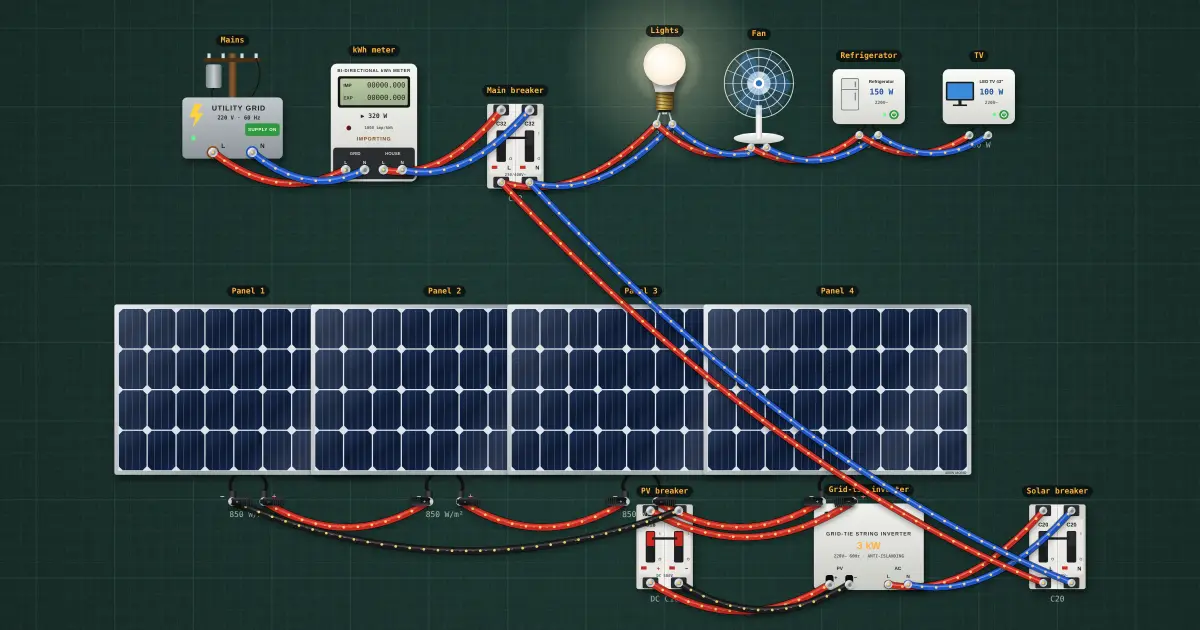
The grid, a kWh meter and main breaker, a 3 kW grid-tie inverter on four panels, and the house loads. Switch the grid off and watch. A grid-tie inverter has no battery and no output of its own: it pushes the panel’s power into the grid’s 220 V. When Meralco or the co-op goes down, the inverter must stop within a fraction of a second (anti-islanding: it would otherwise electrocute the lineman fixing the fault), so the house goes dark with the sun shining on the roof. Backup in a brownout needs a battery and a hybrid or an inverter with a transfer switch.
Build it in the labGuided build, test sheet and fault finding, free in your browser.
Parts list
- Utility grid
- Net meter
- 2 × AC breaker
- 220 V bulb
- 220 V desk fan
- 2 × Household appliance
- 4 × Solar panel
- DC breaker
- Grid-tie inverter
Test procedure
Each test has an expected value and a pass range, like a factory test sheet:
- Grid up, noon: the inverter feeds the house (after its start-up wait)
- Grid up: the TV has 220 V
- Brownout at noon
- Brownout: the house is dark with the sun up
- Grid back: the inverter reconnects after its wait
How it works
What it does: The grid, a kWh meter and main breaker, a 3 kW grid-tie inverter on four panels, and the house loads. Switch the grid off and watch.
Build it (guided or ready-made), then run its test procedure below. Every test has an expected value and a pass range, just like a factory test sheet.
Background
Pag brownout, may kuryente ba ang solar? Not a grid-tie system. This is the single most common surprise for new solar owners in the Philippines.