24 V truck or boat cabin: 12 V for a fan and a lamp, USB for a phone, and a 24 V fan, from a 24 V battery
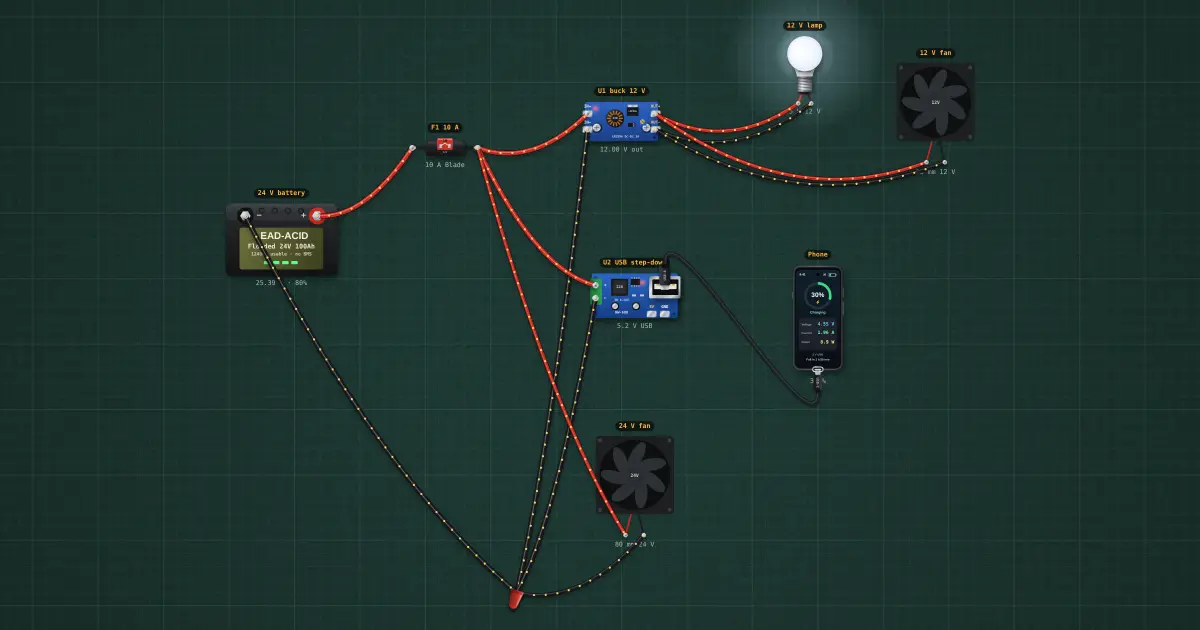
12 V and USB power in a 24 V vehicle, plus a 24 V cabin fan. Trucks, buses and many boats run on 24 V, and most gadgets want 12 V or 5 V. From the 24 V battery, through a 10 A fuse: a buck module set to 12 V runs a 12 V fan and a 12 V lamp; a USB step-down module (9–36 V in) charges a phone straight from 24 V; and a 24 V fan runs directly. Never plug a 12 V gadget straight into 24 V: it burns.
Build it in the labGuided build, test sheet and fault finding, free in your browser.
Parts list
Test procedure
Each test has an expected value and a pass range, like a factory test sheet:
- 12 V rail
- USB port
- 24 V fan speed
- Battery current
How it works
What it does: 12 V and USB power in a 24 V vehicle, plus a 24 V cabin fan.
Build it (guided or ready-made), then run its test procedure below. Every test has an expected value and a pass range, just like a factory test sheet.
Background
The cigarette-lighter “24 V to 12 V converters” in truck stops are a buck module in a box.
More builds: everyday gadgets
- 12 V solar lantern and power box in an enclosure: two 32700 LiFePO4 cells, USB-C and solar charging, 12 V and USB outputs
- Rechargeable flashlight: 21700 cell, USB-C TP4056, clicky switch, 2.8 A driver and a 10 W LED
- Rechargeable 12 V bulb on two 32700 LiFePO4 cells: 2S BMS, USB-C 2S charger and a 12 V boost
- DIY battery spot welder: 12 V battery, MOSFET control board, 8 AWG probes and nickel strip
- Handheld fan on one 18650 cell: USB-C TP4056, switch and a 3.7 V fan motor
- Quiet 12 V cooling fans from a USB-C phone charger: PD trigger board and two 120 mm fans