Smartphone
Smartphone · USB-C · 4500 mAh Li-ion · charges at up to 18 W (USB PD 9 V 2 A) · shows its charging volts, amps and watts on screen
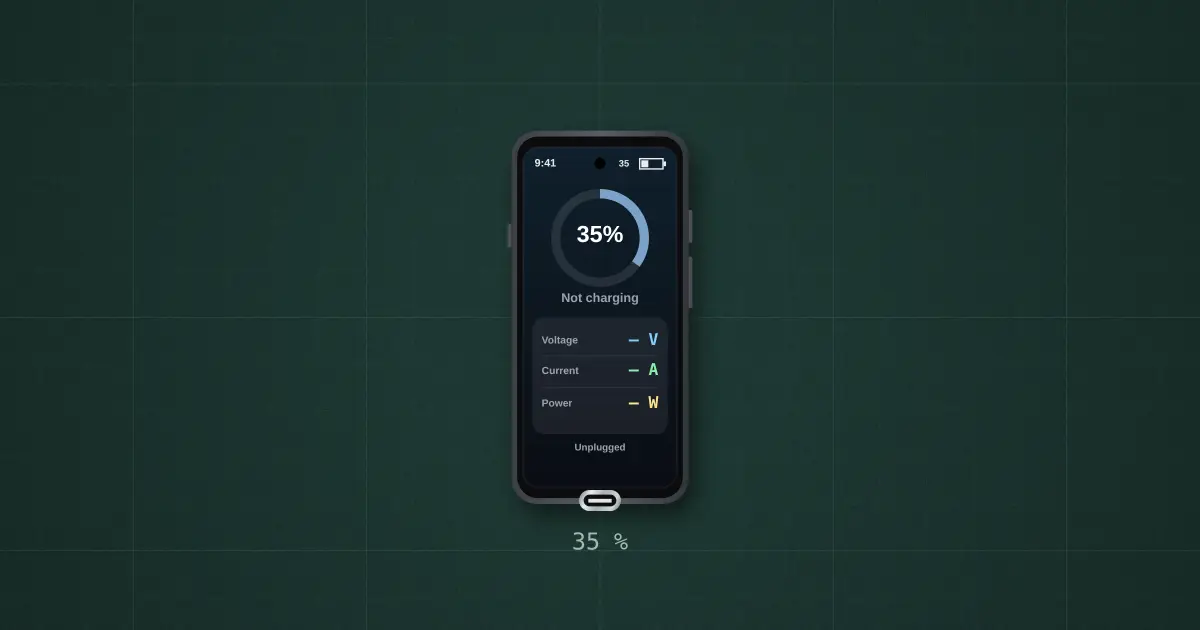
Try it on the benchThe lab drops it on an empty bench and opens its datasheet card.
Typical part: Generic USB-C smartphone (single-cell Li-ion, USB PD 18 W fast charging)
Pins
- USB-C port
Ratings and limits
| Battery | 4500 mAh single Li-ion cell, 3.4–4.2 V (about 17.3 Wh) |
|---|---|
| Charge input | 5 V up to 2 A (10 W); with USB PD 9 V up to 2 A (18 W) |
| Charger detection | USB-A: BC1.2 (D+/D− shorted = wall charger 2 A; computer port 500 mA; charging port 1.5 A). USB-C: the Rp level on CC (default / 1.5 A / 3 A), then USB PD if the cable is C-to-C |
| AICL | adaptive input current limit: if VBUS sags under about 85 % of the expected voltage the phone draws less current, so a weak charger or thin cable still works, just slower |
| Charging | constant current to about 80 %, then constant voltage at 4.2 V while the current tapers off |
| Over-voltage | charging stops if VBUS is more than about 1.3 V above what was agreed |
| Screen readout | volts, amps and watts measured at the phone’s own USB port (after the cable), averaged over about half a second, like a charging app |
How to use it
Plug it into a USB charger with a USB cable to see how charger type, cable and USB PD change the charging power. A watt meter on the charger’s input shows the power taken from the wall side, so you can work out the charger’s efficiency.
Lessons and builds that use it
- Phone charging: volts, amps and watts
- 200 Ah power station from four 3.2 V prismatic LiFePO4 cells: 4S BMS, 2 × 12 V, 3 × USB, mains charger (build)
- 200 Ah power station on a 12.8 V LiFePO4 battery: 2 × 12 V, 3 × USB, mains charger (build)
More in usb & power interfaces
- USB charger / port
- USB-to-serial adapter
- USB-C PD charger
- USB-C PD source controller
- Synchronous buck converter IC
- USB-C PD trigger + meter
- USB-C breakout
- Current-mode PWM controller
- Flyback transformer
- High-voltage N-MOSFET
Sources: USB BC1.2 and USB Type-C specifications (CC Rp/Rd levels), USB PD 3.0 fixed supplies; typical phone charger ICs (input current limit and AICL behaviour)