200 Ah power station on a 12.8 V LiFePO4 battery: 2 × 12 V, 3 × USB, mains charger
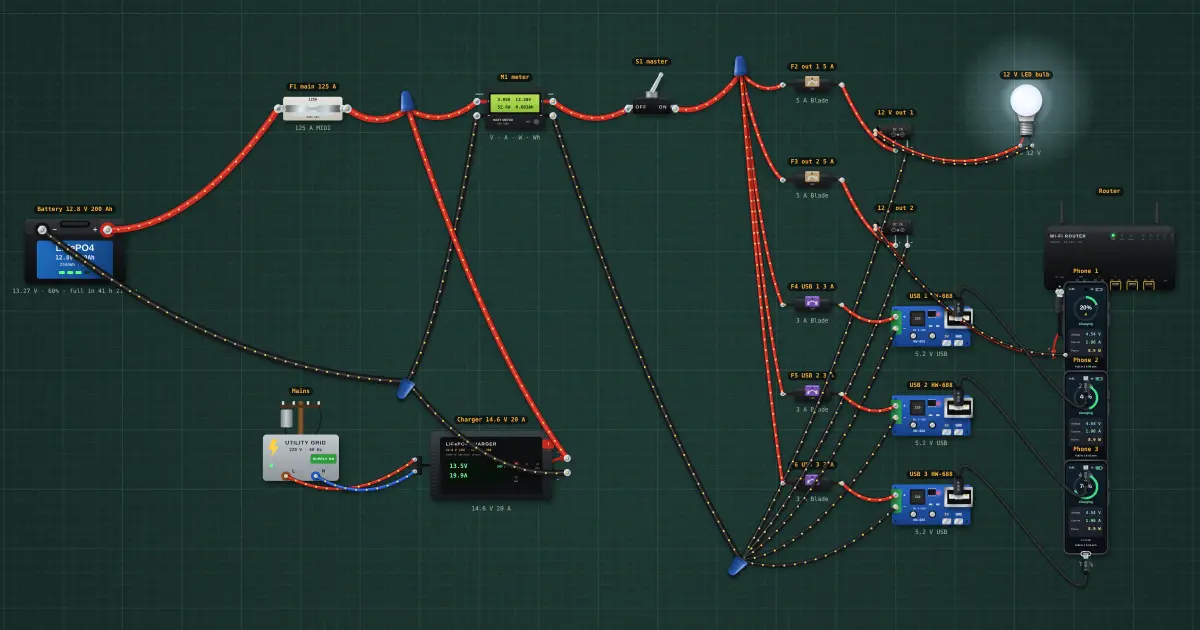
12.8 V 200 Ah (2560 Wh) power station on a drop-in battery, two fused 12 V outputs, three USB outputs, a watt meter and a 20 A mains charger. The same power station on a finished 12.8 V 200 Ah LiFePO4 battery (2560 Wh) with its 200 A BMS inside the case, so the pack side is two terminals and nothing else. Everything on the output board is the one from the cell build: F1 125 A MIDI fuse, M1 DC watt meter, S1 master switch, two 12 V jack outputs at pack voltage with 5 A fuses (a 9 W bulb, a router through a plug), three HW-688 USB outputs behind 3 A fuses with a phone on each, and the 14.6 V 20 A mains charger on the terminals. Compare the two builds in the BOM: the finished battery costs more than the four cells and the BMS, and you cannot see or balance its cells; the cell build is cheaper per Wh, repairable, and needs you to get the busbars, the BMS wiring and the compression right. Same tests on both.
Build it in the labGuided build, test sheet and fault finding, free in your browser.
Parts list
- LiFePO4 battery
- 6 × Fuse
- DC watt meter
- Toggle switch
- 2 × DC barrel jack
- 12 V DC LED bulb
- 12 V Wi-Fi router
- DC barrel plug (bare wires)
- 3 × USB step-down module
- 3 × Smartphone
- Utility grid
- LiFePO4 charger
Test procedure
Each test has an expected value and a pass range, like a factory test sheet:
- The 12 V outputs sit at pack voltage
- 12 V output 2 runs the router
- USB 1 charges its phone at 5 V
- Whole station on the pack: three phones, bulb, router
- Runtime at that load from full
- The charger pushes 20 A into a half-empty pack
- The charger backs off on a full pack
- A dead short on output 1 blows its fuse, not the station
How it works
What it does: 12.8 V 200 Ah (2560 Wh) power station on a drop-in battery, two fused 12 V outputs, three USB outputs, a watt meter and a 20 A mains charger.
Build it (guided or ready-made), then run its test procedure below. Every test has an expected value and a pass range, just like a factory test sheet.
Background
Drop-in 12 V LiFePO4 batteries put the BMS, the cells and the busbars in a sealed case the size of a lead-acid battery: the easy way, and the way most portable power stations are built inside.