200 Ah power station from four 3.2 V prismatic LiFePO4 cells: 4S BMS, 2 × 12 V, 3 × USB, mains charger
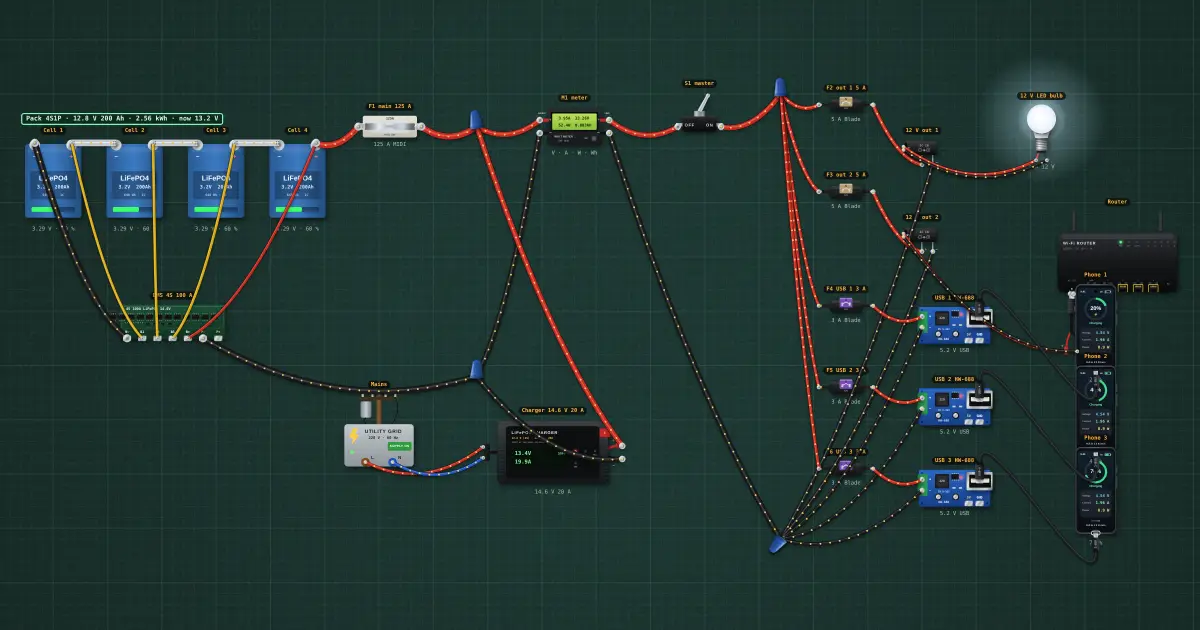
12.8 V 200 Ah (2560 Wh) power station from four prismatic cells with a 4S BMS, two fused 12 V outputs, three USB outputs, a watt meter and a 20 A mains charger. A 12 V 200 Ah portable power station built from cells. Four prismatic LiFePO4 cells (3.2 V 200 Ah, 640 Wh each) in series make 12.8 V 200 Ah, 2560 Wh. A 4S 100 A balancing BMS on the negative side watches every cell: it cuts charging at 3.65 V on any cell, cuts the load at 2.5 V, and balances near full. The output board: an F1 125 A MIDI fuse on the pack positive, M1 (a DC watt meter: volts, amps, watts and the Wh taken since switch-on), S1, a 30 A rocker as the master switch (the MIDI fuse does the protecting: a breaker here would trip magnetically on any output short and take the whole station down with it), then two 12 V jack outputs at pack voltage (12.0 V empty to 14.6 V on the charger, the same range as a car’s socket: a 12 V accessory has to take that, and the cheap LED bulb here runs hot while the charger is on), each with a 5 A blade fuse (here one lights a 9 W 12 V bulb, the other runs a Wi-Fi router through a plug), and three HW-688 USB outputs (5.2 V up to 5 A each) behind 3 A blade fuses, a phone on each. Charging: a 14.6 V 20 A LiFePO4 mains charger on the pack terminals (CC/CV, stops at 2 A, restarts at 13.4 V); 20 A is 0.1 C, about 10 hours from empty. The readings panel shows the runtime at the load of the moment: the whole station busy (three phones, bulb, router, about 60 W) runs for about 38 hours, the router alone for a week.
Build it in the labGuided build, test sheet and fault finding, free in your browser.
Parts list
- 4 × LiFePO4 prismatic cell
- 4S LiFePO4 BMS 100 A
- 6 × Fuse
- DC watt meter
- Toggle switch
- 2 × DC barrel jack
- 12 V DC LED bulb
- 12 V Wi-Fi router
- DC barrel plug (bare wires)
- 3 × USB step-down module
- 3 × Smartphone
- Utility grid
- LiFePO4 charger
Test procedure
Each test has an expected value and a pass range, like a factory test sheet:
- The 12 V outputs sit at pack voltage
- 12 V output 2 runs the router
- USB 1 charges its phone at 5 V
- Whole station on the pack: three phones, bulb, router
- Runtime at that load from full
- The charger pushes 20 A into a half-empty pack
- The charger backs off on a full pack
- A dead short on output 1 blows its fuse, not the station
- Cells share the load evenly
- One flat cell: the BMS cuts the load, the station goes dark
How it works
What it does: 12.8 V 200 Ah (2560 Wh) power station from four prismatic cells with a 4S BMS, two fused 12 V outputs, three USB outputs, a watt meter and a 20 A mains charger.
Build it (guided or ready-made), then run its test procedure below. Every test has an expected value and a pass range, just like a factory test sheet.
Background
Prismatic cells (EVE, CATL, REPT) are what the big "DIY LiFePO4" banks are built from: four cells, a BMS, compression plates and busbars, at a fraction of the price of a finished battery of the same capacity.