DIY battery spot welder: 12 V battery, MOSFET control board, 8 AWG probes and nickel strip
Welds nickel strip onto 18650, 21700 and 32700 cells to build battery packs. A spot welder is a huge, short pulse: a 12 V battery pushes several hundred amps for about 12 ms through the probes, and the strip melts in two small spots under them before heat can reach the cell. The control board is a bank of MOSFETs and a timer; in auto mode it fires 0.4 s after both probes touch the strip. Everything in the loop counts: the battery’s internal resistance, the 2 AWG battery leads, the 8 AWG probe cables and the MOSFETs, against a strip that is only about a milliohm. Too short a pulse and the strip peels off; too long and it blows a hole. Start short on scrap and work up.
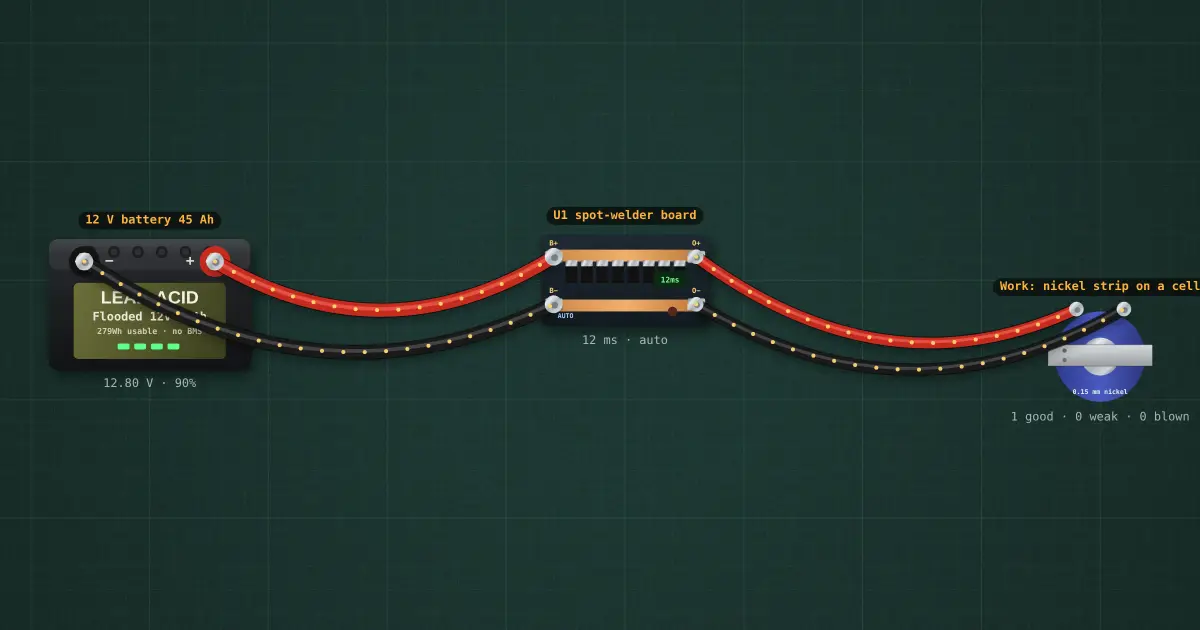
Build it in the labGuided build, test sheet and fault finding, free in your browser.
Parts list
Test procedure
Each test has an expected value and a pass range, like a factory test sheet:
- 12 ms pulse: peak current
- 12 ms on 0.15 mm nickel: a good weld
- 3 ms: too short, the strip peels off
- 40 ms on 0.1 mm: blown through
How it works
What it does: Welds nickel strip onto 18650, 21700 and 32700 cells to build battery packs.
Build it (guided or ready-made), then run its test procedure below. Every test has an expected value and a pass range, just like a factory test sheet.
Background
Kits like this made DIY battery packs common: a car battery and a ₱1,000 board replace a ₱15,000 capacitor-discharge welder.
More builds: everyday gadgets
- 12 V solar lantern and power box in an enclosure: two 32700 LiFePO4 cells, USB-C and solar charging, 12 V and USB outputs
- Rechargeable flashlight: 21700 cell, USB-C TP4056, clicky switch, 2.8 A driver and a 10 W LED
- Rechargeable 12 V bulb on two 32700 LiFePO4 cells: 2S BMS, USB-C 2S charger and a 12 V boost
- Handheld fan on one 18650 cell: USB-C TP4056, switch and a 3.7 V fan motor
- Quiet 12 V cooling fans from a USB-C phone charger: PD trigger board and two 120 mm fans
- 24 V truck or boat cabin: 12 V for a fan and a lamp, USB for a phone, and a 24 V fan, from a 24 V battery