Light with one switch
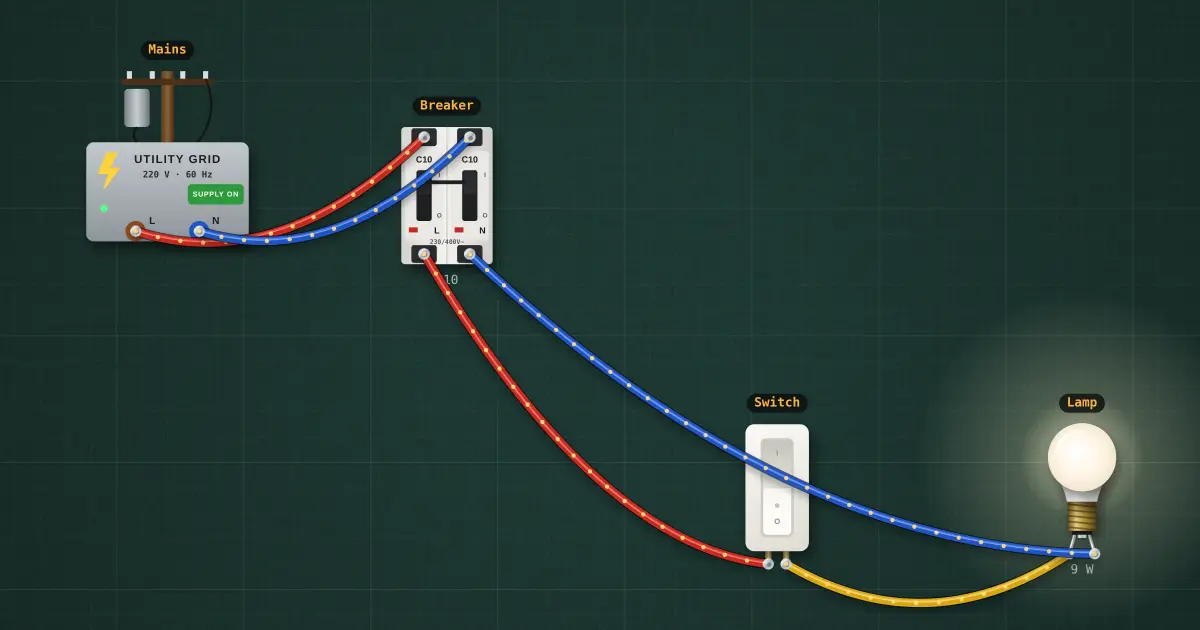
One 9 W LED bulb on a 1-way wall switch, fed from a 10 A breaker. The simplest lighting circuit in a house: breaker → wall switch → lamp → back on the neutral. The switch must break the LINE (L), never the neutral, so the lamp holder is dead when the switch is off and you can change the bulb safely.
Build it in the labGuided build, test sheet and fault finding, free in your browser.
Parts list
Test procedure
Each test has an expected value and a pass range, like a factory test sheet:
- Switch on: the lamp lights at its rating
- Switch off: the lamp is off
- Switch off: the lamp holder is dead (the switch breaks L, not N)
- Breaker off: the whole circuit is dead
- Cable sized for the breaker
How it works
What it does: One 9 W LED bulb on a 1-way wall switch, fed from a 10 A breaker.
Build it (guided or ready-made), then run its test procedure below. Every test has an expected value and a pass range, just like a factory test sheet.
Background
Every room starts here. A switch in the neutral still turns the lamp off, which is why the mistake goes unnoticed until someone touches a "dead" bulb socket and finds it live at 220 V.
More builds: power, transformers and three-phase
- Adjustable bench supply 1.25–20 V
- Staircase light: two 3-way switches
- Fan and light on a 2-gang switch
- Outlet circuit: three outlets on a 20 A breaker
- House panel: main breaker and four branch circuits
- RCD protection: someone touches a live wire
- Aircon branch circuit: 1.5 HP on 3.5 mm² and a 20 A breaker, on its own
- Water heater circuit: 3.5 kW on 5.5 mm² and a 30 A breaker