RCD protection: someone touches a live wire
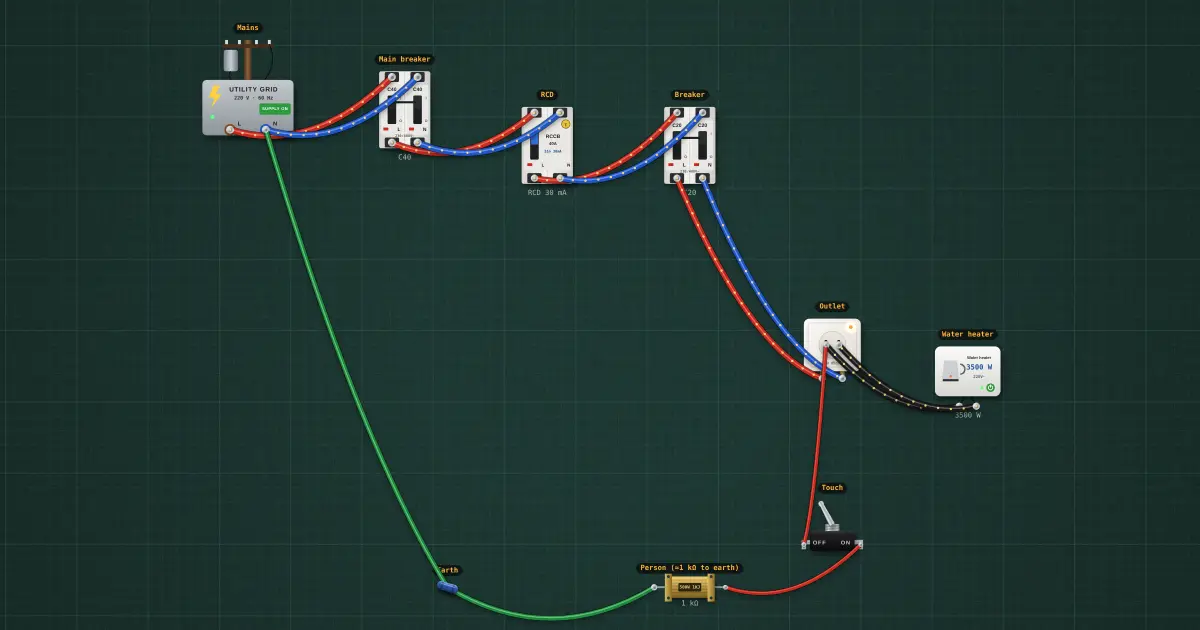
A water-heater circuit behind a 30 mA RCD, with a switch that lets a "person" (about 1 kΩ, hand to wet feet) touch the live wire. A breaker trips on overload and short circuits: tens or hundreds of amps. A person touching 220 V and standing on a wet floor passes about 0.2 A to earth, enough to stop the heart and far too little for any breaker. The current goes out on L and returns through the earth, not on N. An RCD compares L and N and trips on a 30 mA difference within 40 ms.
Build it in the labGuided build, test sheet and fault finding, free in your browser.
Parts list
Test procedure
Each test has an expected value and a pass range, like a factory test sheet:
- Normal use: the 3.5 kW heater runs, the RCD stays on
- A person touches the live wire: the RCD trips
- After the trip, no current through the person
- Without the RCD (bypassed): current through the person
- Without the RCD: the 20 A breaker never notices
- Test button
How it works
What it does: A water-heater circuit behind a 30 mA RCD, with a switch that lets a "person" (about 1 kΩ, hand to wet feet) touch the live wire.
Build it (guided or ready-made), then run its test procedure below. Every test has an expected value and a pass range, just like a factory test sheet.
Background
RCDs (also RCCB, GFCI, ELCB) are required on bathroom, outdoor and kitchen circuits in most wiring codes. Press the T button monthly: it leaks a test current inside the device and should trip it at once.
More builds: power, transformers and three-phase
- Adjustable bench supply 1.25–20 V
- Light with one switch
- Staircase light: two 3-way switches
- Fan and light on a 2-gang switch
- Outlet circuit: three outlets on a 20 A breaker
- House panel: main breaker and four branch circuits
- Aircon branch circuit: 1.5 HP on 3.5 mm² and a 20 A breaker, on its own
- Water heater circuit: 3.5 kW on 5.5 mm² and a 30 A breaker