Run 12 V things from a USB-C charger: PD trigger board, watt meter, 12 V lamp and a USB step-down
Turns a USB-C phone charger that offers 12 V into a 12 V supply with a meter. A USB-C PD charger gives 5 V until something asks for more. A trigger board asks for 12 V and switches its output on once the charger agrees. Check the charger’s label first: most 20–30 W phone chargers offer 12 V, but many laptop chargers jump from 9 V straight to 15 V and refuse 12 V (then ask for 15 V and add a buck module set to 12 V). An inline watt meter shows volts, amps and watts, then the 12 V runs a lamp (or a router, an LED strip, a fan), and a USB step-down module makes 5 V for a phone at the same time. Three boards, no soldering beyond screw terminals.
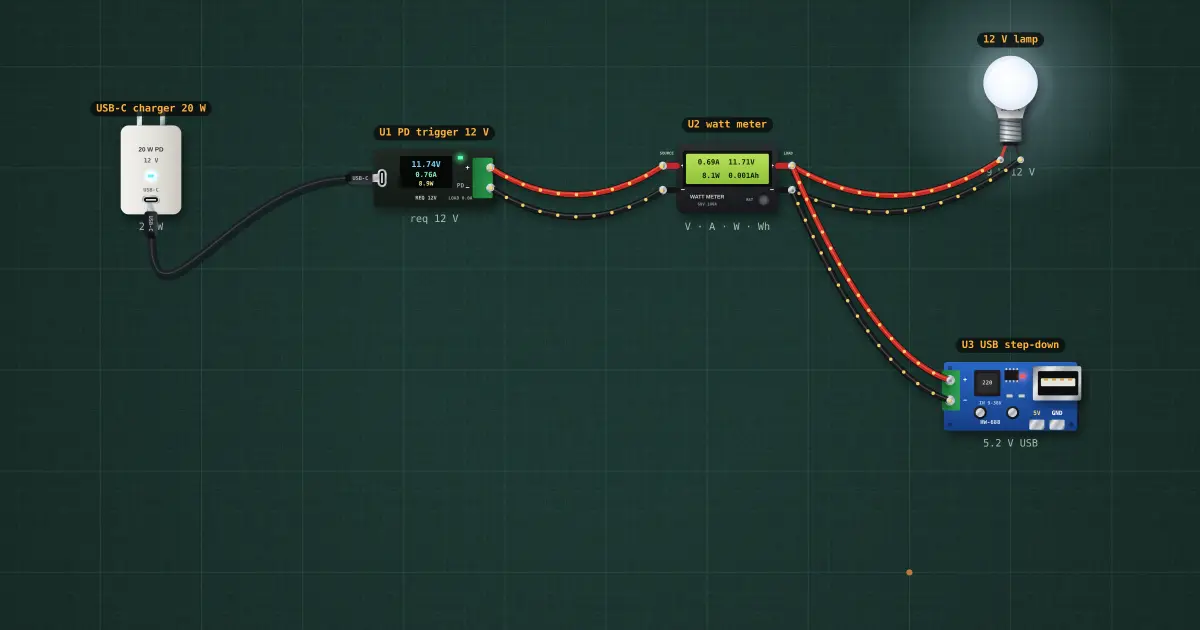
Build it in the labGuided build, test sheet and fault finding, free in your browser.
Parts list
Test procedure
Each test has an expected value and a pass range, like a factory test sheet:
- Output voltage
- Lamp current
- USB output
- Power drawn from the charger
How it works
What it does: Turns a USB-C phone charger that offers 12 V into a 12 V supply with a meter.
Build it (guided or ready-made), then run its test procedure below. Every test has an expected value and a pass range, just like a factory test sheet.
Background
USB-C PD (2015 onwards) made laptop chargers into adjustable power supplies; trigger boards cost less than a meal.
More builds: module builds
- Solar floodlight, the module way: LiFePO4 charger board, BMS, LED board and a panel-sensed dusk switch
- 12 V battery from three 18650s: 3S BMS, USB-C laptop-charger charging, capacity meter, 12 V and USB outputs
- Wi-Fi router mini UPS: TP5000 charger, 1S BMS, four 18650s and a TPS61088 boost set to 12 V
- Bright LED panel on a 12 V LiFePO4 battery: low-voltage cut-off, CC/CV buck at 3 A, LED board
- Brownout fan: USB-C charger board, one 21700 cell, a 5 V boost module and a DC fan