Solar floodlight, the module way: LiFePO4 charger board, BMS, LED board and a panel-sensed dusk switch
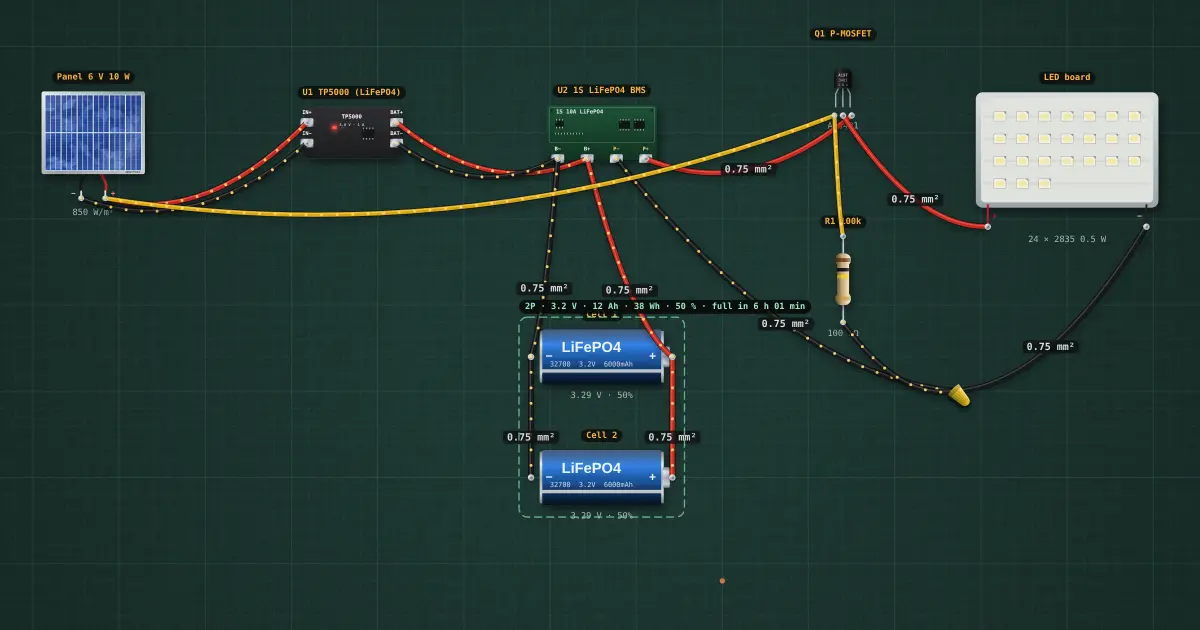
Charges by day, lights by itself at night, and the BMS stops the cells being over-charged or run flat. A proper version of the cheap solar floodlight, from parts you can buy as boards. A 6 V 10 W panel feeds a TP5000 charger board set to LiFePO4 (3.6 V full), through a 1S LiFePO4 protection board, into two 32700 cells in parallel (12 Ah). The 24-LED board runs straight from the 3.2 V cells through its own small resistors: about 1.1 A (45 mA per LED, well under their 150 mA rating), so the cells last about 10 hours and the LEDs barely get warm. The dusk switch is one P-MOSFET and one resistor: by day the panel’s voltage holds the gate high and the light is off; at night the panel goes dark, R1 pulls the gate low and the light comes on. No light sensor needed: the panel is the sensor.
Build it in the labGuided build, test sheet and fault finding, free in your browser.
Parts list
- Small poly panel
- TP5000 charger module
- 1S LiFePO4 protection board
- 2 × LiFePO4 cell
- P-channel MOSFET
- Resistor
- LED board
Test procedure
Each test has an expected value and a pass range, like a factory test sheet:
- Full sun: the light stays off
- Full sun: charge current into the cells
- Night: the light comes on by itself
- Charged cells stop at LiFePO4 full
How it works
What it does: Charges by day, lights by itself at night, and the BMS stops the cells being over-charged or run flat.
Build it (guided or ready-made), then run its test procedure below. Every test has an expected value and a pass range, just like a factory test sheet.
Background
Most solar floodlights sold online skip the charger and the BMS and put the panel straight on the cells. Two small boards make the same light last for years.
More builds: module builds
- 12 V battery from three 18650s: 3S BMS, USB-C laptop-charger charging, capacity meter, 12 V and USB outputs
- Wi-Fi router mini UPS: TP5000 charger, 1S BMS, four 18650s and a TPS61088 boost set to 12 V
- Run 12 V things from a USB-C charger: PD trigger board, watt meter, 12 V lamp and a USB step-down
- Bright LED panel on a 12 V LiFePO4 battery: low-voltage cut-off, CC/CV buck at 3 A, LED board
- Brownout fan: USB-C charger board, one 21700 cell, a 5 V boost module and a DC fan