Bright LED panel on a 12 V LiFePO4 battery: low-voltage cut-off, CC/CV buck at 3 A, LED board
A steady, bright 10 W light from a 12 V battery that protects the battery by itself. LEDs want a set current, not a set voltage. A CC/CV buck module (XL4015) set to 4.2 V and 3 A drives a 24-LED board at about 125 mA per LED, whatever the battery is doing. A fuse and an on/off switch sit at the battery; after them a low-voltage disconnect module set to LiFePO4 switches the light off at 12.0 V so the battery is never run flat, and back on at 13.0 V. Turn the CV trimmer to 4.2 V first (just above what the board needs at 3 A, so the current limit is what sets the brightness), then short the output through a meter and set the CC trimmer to 3 A.
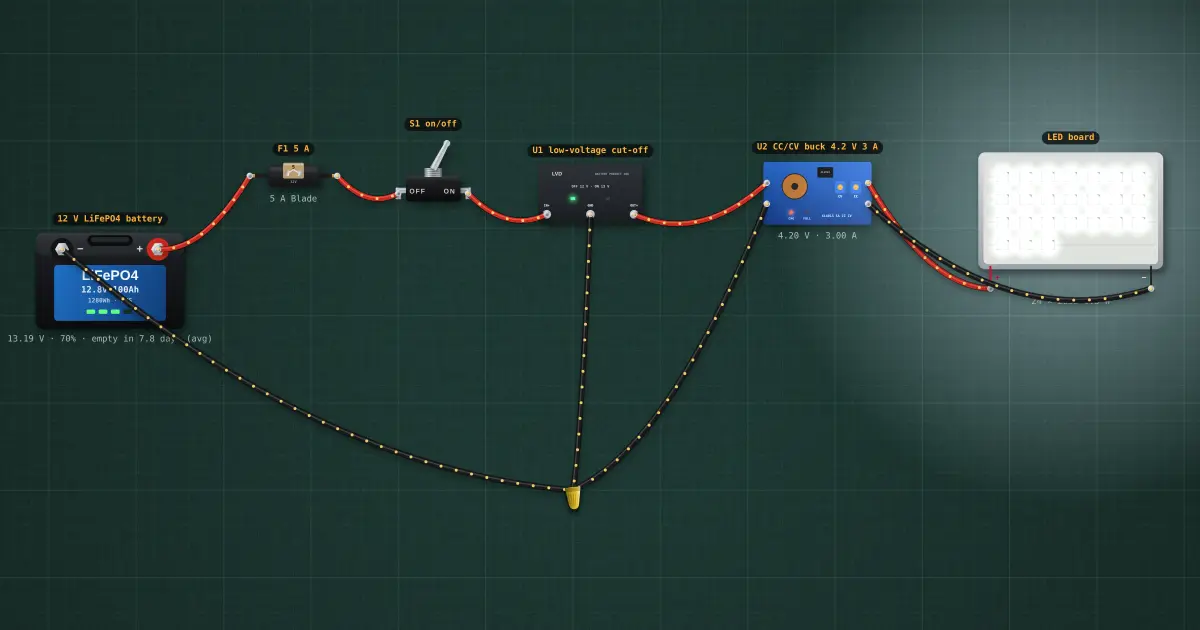
Build it in the labGuided build, test sheet and fault finding, free in your browser.
Parts list
Test procedure
Each test has an expected value and a pass range, like a factory test sheet:
- LED current (the CC setting)
- Battery current (less than the LED current)
- Battery almost empty: the light switches off
How it works
What it does: A steady, bright 10 W light from a 12 V battery that protects the battery by itself.
Build it (guided or ready-made), then run its test procedure below. Every test has an expected value and a pass range, just like a factory test sheet.
Background
Constant-current drivers are why modern LED lights stay the same brightness until the battery is almost empty.
More builds: module builds
- Solar floodlight, the module way: LiFePO4 charger board, BMS, LED board and a panel-sensed dusk switch
- 12 V battery from three 18650s: 3S BMS, USB-C laptop-charger charging, capacity meter, 12 V and USB outputs
- Wi-Fi router mini UPS: TP5000 charger, 1S BMS, four 18650s and a TPS61088 boost set to 12 V
- Run 12 V things from a USB-C charger: PD trigger board, watt meter, 12 V lamp and a USB step-down
- Brownout fan: USB-C charger board, one 21700 cell, a 5 V boost module and a DC fan