Full adder
A full adder adds three bits: A, B and the carry from the column to the right. Two half adders and an OR gate do it. Chain four of them and you can add 4-bit numbers.
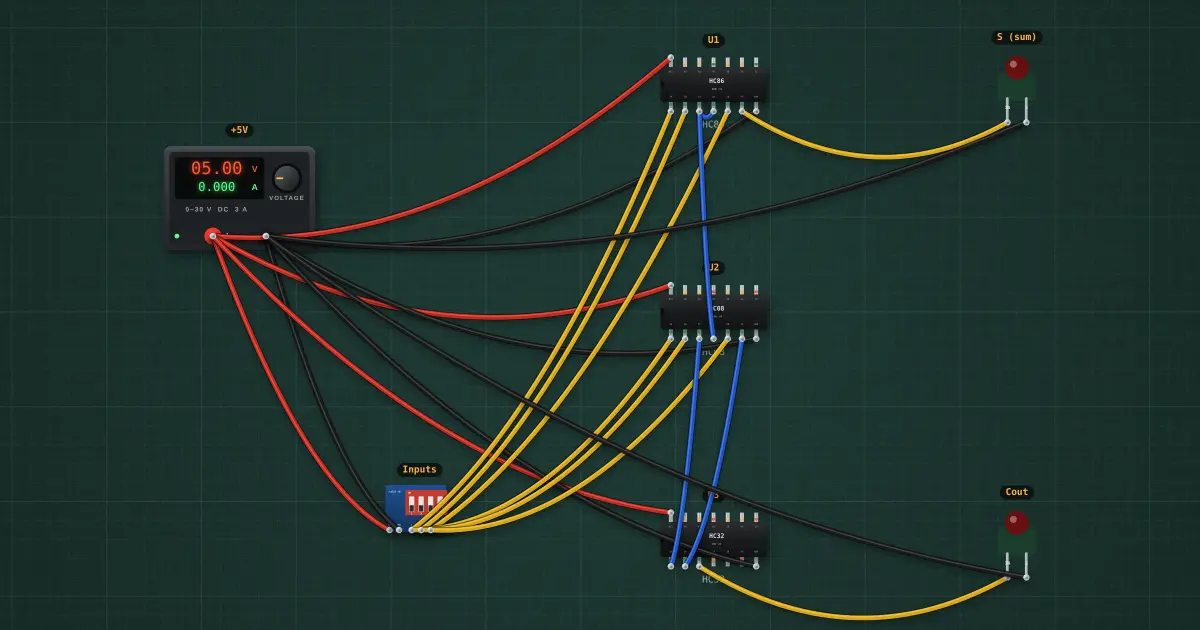
Open this lesson in the labFree, in your browser, no account needed.
How it works
S = A ⊕ B ⊕ Cin · Cout = A·B + Cin·(A ⊕ B)
| A | B | Cin | Cout | S | bench | |
|---|---|---|---|---|---|---|
| 0 | 0 | 0 | 0 | 0 | — | |
| 0 | 0 | 1 | 0 | 1 | — | |
| 0 | 1 | 0 | 0 | 1 | — | |
| 0 | 1 | 1 | 1 | 0 | — | |
| 1 | 0 | 0 | 0 | 1 | — | |
| 1 | 0 | 1 | 1 | 0 | — | |
| 1 | 1 | 0 | 1 | 0 | — | |
| 1 | 1 | 1 | 1 | 1 | — |
Flip the switches to try every row. “bench” fills in with what the chip actually did.
Switch 3 is Cin. Cout S is the 2-bit count of how many inputs are 1.
Try it on the bench
- Turn on all three switches: 1 + 1 + 1 = 11 in binary, so both lights come on.
- Count the ON switches in each row and compare with Cout S read as a binary number.
Parts on the bench
- Bench power supply
- DIP switch module
- 74xx86
- 74xx08
- 74xx32
- 2 × Logic indicator LED
In the course
Zen’s Electronics Design Mastery, module “Digital Electronics”.