Battery monitor with shunt (coulomb counter) (TF03K)
Shunt 100 A / 75 mV · 100 Ah LiFePO4 12.8 V · counts amp-hours
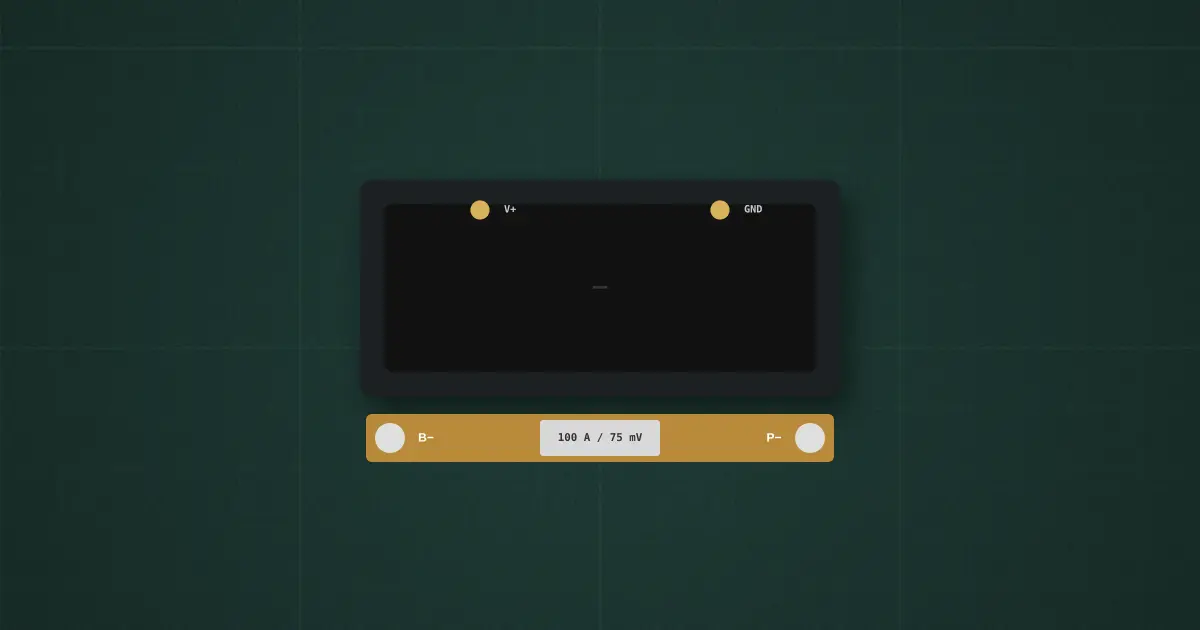
Try it on the benchThe lab drops it on an empty bench and opens its datasheet card.
Typical part: Shunt battery monitor (coulomb counter) with LCD, KG-F / TF03K class; 75 mV shunt
Pins
- B− (battery negative: the shunt’s battery side)
- P− (system negative: every load and charger goes here)
- V+ sense (battery +)
- GND of the meter (to B−)
Ratings and limits
| How it measures | current: the voltage across a 75 mV shunt (100 A shunt = 0.75 mΩ, so 1 A gives 0.75 mV); state of charge: amp-hours counted in and out against the capacity you set |
|---|---|
| Wiring | the shunt goes in the battery NEGATIVE lead: B− to the battery, P− to every load and charger negative. Anything wired straight to the battery’s − terminal is not counted |
| Synchronising | it sets itself to 100 % when the battery sits at its full voltage with only a small tail current (here 4 % of capacity for LiFePO4, held for a minute). Without full charges the count drifts |
| Why not voltage | on LiFePO4 the resting voltage hardly moves between 20 % and 90 % (13.1–13.3 V): a voltage gauge reads “full” until the very end |
| Self consumption | about 10–15 mA from V+ (not counted, it is before the shunt) |
| Accuracy | about ±1 % plus a small zero offset: over days the offset adds up, the full-charge sync clears it |
How to use it
The battery gauge for any system with a real load: solar, vans, piso charging stations. Set the capacity in Ah and the chemistry, then charge to full once to synchronise.
More in batteries & cells
- 9 V battery
- AA cell
- 18650 Li-ion cell
- 21700 Li-ion cell
- LiFePO4 cell
- LiFePO4 prismatic cell
- LiFePO4 prismatic cell 50 Ah
- LiFePO4 prismatic cell 105 Ah
- Flat Li-ion battery
- 18650 battery holder
Sources: Victron BMV/SmartShunt manual (shunt in the negative, synchronisation parameters, tail current); typical KG140F / TF03K coulomb meter manuals.