Supercapacitor
10 F 2.7 V EDLC cell · ESR 75 mΩ · ±20 %
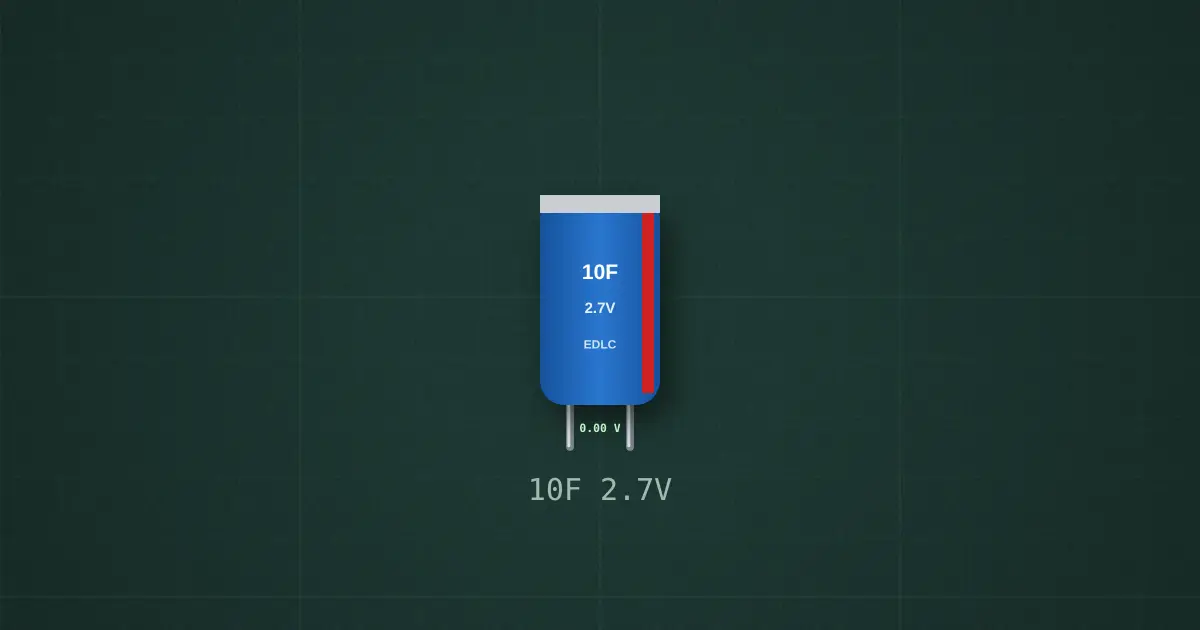
Try it on the benchThe lab drops it on an empty bench and opens its datasheet card.
Typical part: EDLC supercapacitor: single 2.7 V cell, or a 5.5 V module (two cells + balancing)
Pins
- +
- −
Ratings and limits
| Voltage | 2.7 V per cell. Above about 2.85 V the electrolyte breaks down: the cell gasses, bulges and loses capacity |
|---|---|
| Capacitance | farads, ±20 % (this part’s actual value is set at random within that, like a real one) |
| ESR | tens of milliohms: it can give amps in a burst, with an instant drop of I × ESR |
| Leakage | tens of µA after a few hours: it discharges itself over days |
| In series | two cells share the voltage inversely to their capacitance: with ±20 % one may get 3 V on a 5 V rail. Modules add balancing resistors; bare cells need them too |
| Charging | an empty supercap is a short circuit: limit the inrush (resistor or current-limited supply) |
How to use it
Holding a rail up through short heavy bursts (a modem’s 2 A GSM slots) and keeping an RTC alive for days without a battery. Energy is ½CV², so most of it is in the top half of the voltage.
More in passive components
- Resistor
- Potentiometer
- Photoresistor (LDR)
- Electrolytic capacitor
- Film capacitor
- Toroidal inductor
- Ceramic capacitor
- Variable capacitor
- Axial choke
- Ferrite bead
Sources: Eaton/Maxwell EDLC datasheets (2.7 V rating, ESR, leakage, series balancing application notes).