AC-coupled solar with battery
You already have a grid-tie system and want backup. The battery goes on the AC side through its own inverter/charger, not through the panels. The lab shows the wiring; the control trick is in the notes.
Open it in the simulator ▸Size it from my electric bill
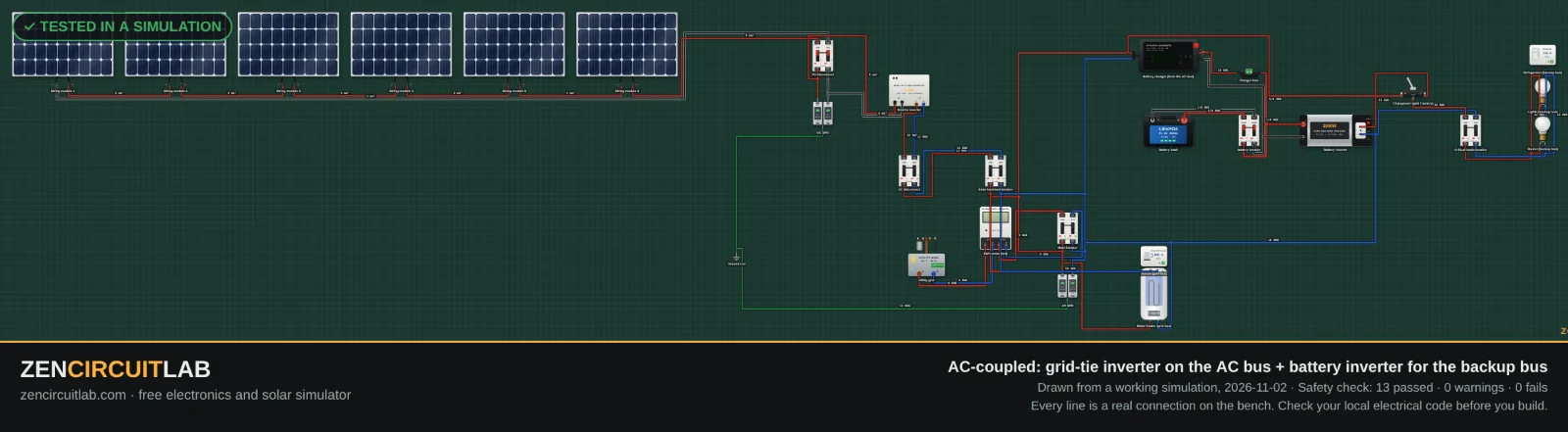
What is in it
2,700 W of panels, a 24 V 200 Ah LiFePO4 battery (5.1 kWh), 5,000 W of inverter. 28 parts in all, wired and sized the way the lab's solar studio sizes them.
- The existing grid-tie system
Unchanged: string, DC disconnect, SPD, grid-tie inverter, backfeed breaker on the busbar. - A battery with its own inverter/charger on the AC side
The panels never see the battery. The charger fills it from the AC bus; the inverter makes 220 V for the critical loads. Two conversions (AC→DC→AC), which is the cost of a retrofit. - The backup bus through a changeover
Fridge, lights and router move to the battery inverter when the grid goes; the aircon and heater stay on the grid bus and go dark. (The lab’s changeover is a manual switch; a real battery inverter switches in a few cycles.) - The control trick the lab does not model
In a real AC-coupled system the battery inverter forms the grid during an outage and the grid-tie inverter keeps running into it; when the battery is full, the battery inverter raises the frequency a hertz or two and the grid-tie inverter throttles back (frequency-watt). Without that, a full battery and a sunny day would overcharge it. Here, in an outage the grid-tie inverter simply stops (anti-islanding), and the backup bus runs on the battery alone. - Ground rod, SPDs
As every system.
A clear day on this system
The lab ran this exact system through a clear day: 36 hours from 18:00 the evening before. The panels harvested 7.1 kWh and the loads used 29 kWh; the grid supplied 35 kWh; the battery went between 80 % and 100 %.
Parts and prices
Philippine prices as estimates (about US$2,213 in all at ₱64 per US$). In the simulator, Buy all the parts gives the same list with shop links where we have them.
| Part | Qty | Est. |
|---|---|---|
| Grid-tie inverter String inverter 3000 W · MPPT 80–550 V | 1 | ₱27,000 |
| LiFePO4 charger LiFePO4 battery charger for 25.6 V (8S) · AC 100–240 V 50/60 Hz in | 1 | ₱3,000 |
| Power inverter Pure sine 2000 W · DC 24 V in | 1 | ₱14,000 |
| Solar panel 450 W · 144 half-cell mono | 6 | ₱48,600 |
| LiFePO4 battery LiFePO4 25.6 V 200 Ah · 5120 Wh | 1 | ₱37,050 |
| AC breaker 2-pole MCB · C16 | 1 | ₱280 |
| AC breaker 2-pole MCB · C20 | 2 | ₱560 |
| AC breaker 2-pole MCB · C63 | 1 | ₱280 |
| Changeover switch SPDT toggle | 1 | ₱30 |
| DC breaker 2-pole MCB · C125 | 1 | ₱380 |
| DC breaker 2-pole MCB · C16 | 1 | ₱380 |
| Fuse Blade fuse (ATO) in inline holder · 30 A | 1 | ₱45 |
| Surge protector (SPD) AC SPD, Type 2, 275 V · DIN-rail module, two pluggable varistor cartridges with a status window each | 1 | ₱650 |
| Surge protector (SPD) PV DC SPD, Type 2, 600 V · DIN-rail module, two pluggable varistor cartridges with a status window each | 1 | ₱950 |
| Storage water heater Storage water heater · 15 L tank, polyurethane insulated | 1 | ₱3,800 |
| 220 V bulb A60 E27 · LED 10 W | 1 | ₱90 |
| 220 V bulb A60 E27 · LED 54 W | 1 | ₱90 |
| Household appliance Aircon 1 HP inverter · 900 W max, about 495 W once the room is cool | 1 | — |
| Household appliance Refrigerator · 150 W | 1 | — |
| 1/0 AWG battery cable black | 1 m | ₱520 |
| 1/0 AWG battery cable red | 1 m | ₱520 |
| 10 AWG (5.5 mm²) THHN any colour | 2 m | ₱150 |
| 10 AWG (5.5 mm²) THHN black | 1 m | ₱75 |
| 10 AWG (5.5 mm²) THHN red | 2 m | ₱150 |
| 12 AWG (3.5 mm²) THHN any colour | 6 m | ₱288 |
| 12 AWG (3.5 mm²) THHN red | 6 m | ₱288 |
| 14 AWG (2.0 mm²) THHN any colour | 3 m | ₱105 |
| 14 AWG (2.0 mm²) THHN black | 1 m | ₱35 |
| 14 AWG (2.0 mm²) THHN red | 1 m | ₱35 |
| 8 AWG (8.0 mm²) THHN any colour | 1 m | ₱110 |
| 8 AWG (8.0 mm²) THHN red | 1 m | ₱110 |
| PV cable 4 mm² black | 16 m | ₱960 |
| PV cable 4 mm² red | 18 m | ₱1,080 |
| Estimated total | ₱141,611 |
What the safety check verifies
- ✓ Cold-morning Voc inside the Grid-tie inverter's input
- ✓ Hot-noon Vmp stays above the controller’s minimum
- ✓ PV conductors rated for 1.56 × Isc
- ✓ Array-to-controller voltage drop
- ✓ DC disconnect between array and controller
- ✓ Battery inverter set for the 24 V bank
- ✓ Battery to Battery inverter protected: Battery breaker
- ✓ Battery disconnect: Battery breaker
- ✓ Battery-to-inverter drop
- ✓ Grid-tie inverter is grid-interactive (anti-islanding)
- ✓ Surge protection on each side
- ✓ Every SPD’s PE reaches the earth
- ✓ Grounding electrode: the service ground
Questions
How big is this ac-coupled solar with battery?
As drawn: 2,700 W of panels, a 24 V 200 Ah LiFePO4 battery (5.1 kWh), 5,000 W of inverter. Every size can be changed in the simulator, and Solar & wiring → My house sizes one from your electric bill.
Does it work in a brownout?
Only the backup circuit stays on, fed by the battery inverter; the grid-tie inverter keeps working inside that small island, so the sun can still charge the battery.
Is the wiring diagram correct?
It is drawn from the working simulation: every line is a real connection on the bench, and the safety check passes 13 checks with no fails. It is a design to learn from and adapt: check it against your local electrical code and the manuals of the parts you buy.
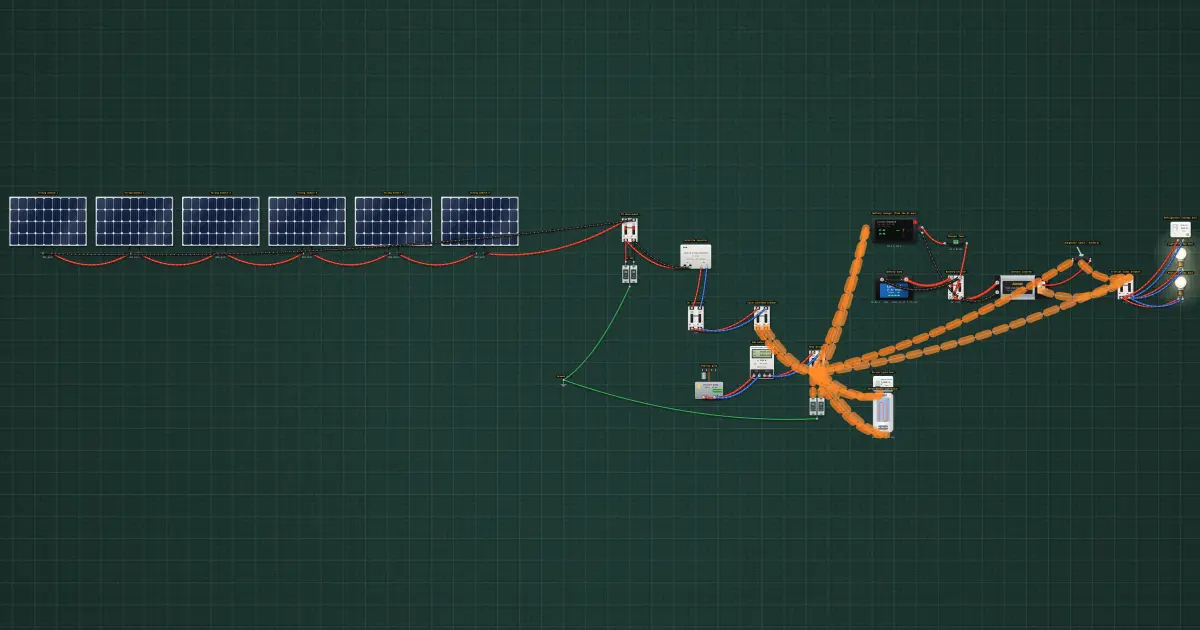
On the bench
Open it in the simulator ▸All solar systems and builds
Other systems
Off-grid solar system · Grid-tie solar system · Hybrid solar system · Off-grid inverter + ATS (budget hybrid) · 12 V solar for an RV, boat or small DIY · Three-phase grid-tie solar