Off-grid solar system
No grid, or a grid you do not want to depend on: a farm, a beach house, a tower site. One conversion from panel to battery, the inverter runs only the loads. The classic.
Open it in the simulator ▸Size it from my electric bill
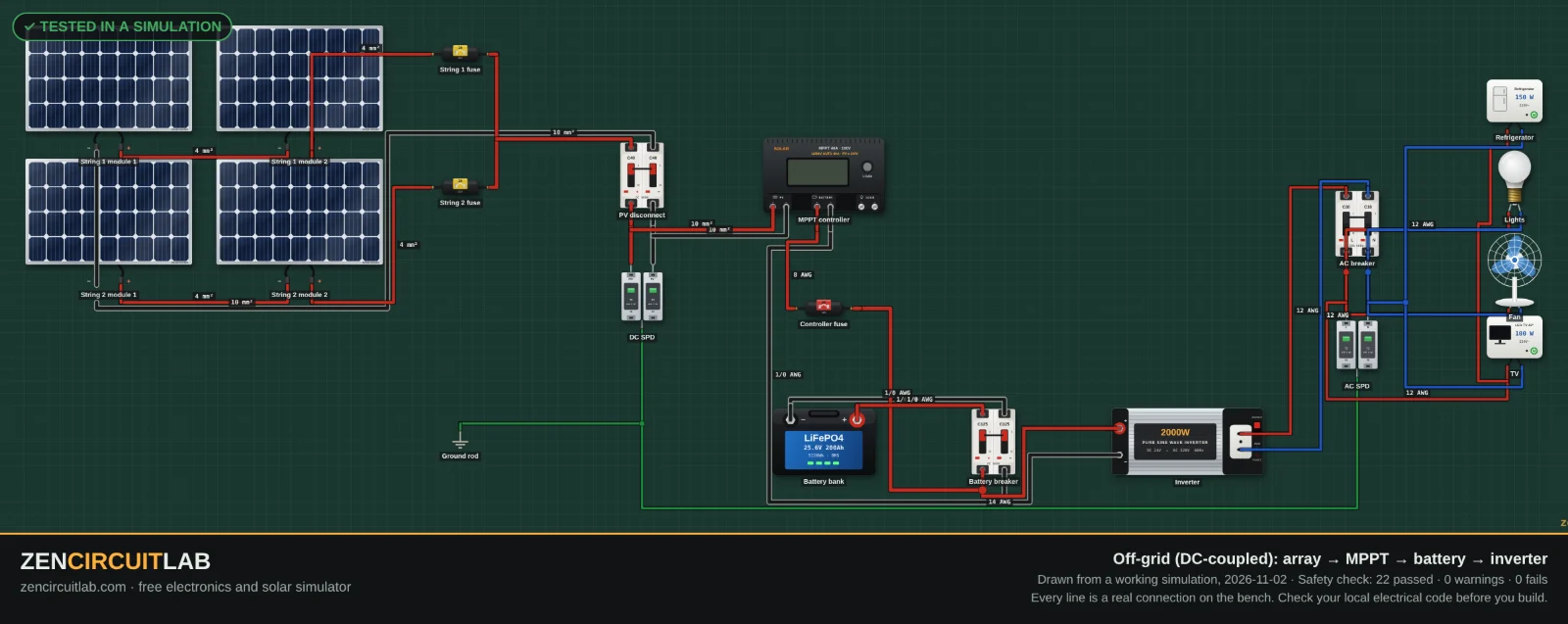
What is in it
800 W of panels, a 24 V 200 Ah LiFePO4 battery (5.1 kWh), 2,000 W of inverter. 20 parts in all, wired and sized the way the lab's solar studio sizes them.
- Two strings of two 200 W modules
2S keeps the string under the controller’s 100 V on a cold morning (2 × 26 V at 10 °C); 2P doubles the current to 22 A. - String fuses, 20 A
With two strings they are optional (NEC 690.9 asks from three); here they also make each string serviceable on its own. - PV disconnect, 40 A 2-pole, 10 mm² PV cable on the 8 m run
The array cannot be switched off; this is how you work on the controller in daylight. The thick cable is for voltage drop: at 40 V and 20 A, 2 % is only 0.8 V. - DC SPD at the controller input
The lightning path from the roof ends here, not in the controller. - MPPT controller, 40 A
800 W ÷ 24 V × 1.25 = 42 A of charge; MPPT because the array runs at 36 V, not the battery’s 27 V. - Controller fuse, 60 A
The battery feeds the controller too; a short in the controller is a battery short. - 24 V 200 Ah LiFePO4, breaker 125 A
4.9 kWh usable for a night; the breaker is the inverter’s 98 A × 1.25, under the 1/0 cable’s 175 A. - 2000 W inverter, AC breaker 16 A, AC SPD
Loads of 1 kW continuous with room for a start surge; the SPD on the AC side because the house wiring is an antenna too. - Ground rod
The electrode the SPDs work against; frames and enclosures bond to it (not drawn). - Loads: a refrigerator, lights, a fan and a TV
The refrigerator’s compressor runs about 10 hours a day (150 W while it runs), the lights 6 hours, the fan 10, the TV 5: about 3 kWh a day. On a clear day the 800 W array harvests about 4.7 kWh, so the battery ends the day well above empty.
A clear day on this system
The lab ran this exact system through a clear day: 36 hours from 18:00 the evening before. The panels harvested 4.7 kWh and the loads used 4.4 kWh; the battery went between 38 % and 96 %.
Parts and prices
Philippine prices as estimates (about US$1,267 in all at ₱64 per US$). In the simulator, Buy all the parts gives the same list with shop links where we have them.
| Part | Qty | Est. |
|---|---|---|
| Power inverter Pure sine 2000 W · DC 24 V in | 1 | ₱14,000 |
| Solar charge controller MPPT 40 A solar charge controller, PV 100 V · MPPT 40 A | 1 | ₱7,200 |
| Solar panel 200 W · 40-cell mono | 4 | ₱14,400 |
| LiFePO4 battery LiFePO4 25.6 V 200 Ah · 5120 Wh | 1 | ₱37,050 |
| AC breaker 2-pole MCB · C16 | 1 | ₱280 |
| DC breaker 2-pole MCB · C125 | 1 | ₱380 |
| DC breaker 2-pole MCB · C40 | 1 | ₱380 |
| Fuse Blade fuse (ATO) in inline holder · 20 A | 2 | ₱90 |
| Fuse Blade fuse (ATO) in inline holder · 60 A | 1 | ₱45 |
| Surge protector (SPD) AC SPD, Type 2, 275 V · DIN-rail module, two pluggable varistor cartridges with a status window each | 1 | ₱650 |
| Surge protector (SPD) PV DC SPD, Type 2, 600 V · DIN-rail module, two pluggable varistor cartridges with a status window each | 1 | ₱950 |
| 220 V bulb A60 E27 · LED 54 W | 1 | ₱90 |
| 220 V desk fan 12-inch desk fan · 40 W | 1 | ₱950 |
| Household appliance LED TV 43" · 100 W | 1 | — |
| Household appliance Refrigerator · 150 W | 1 | — |
| 1/0 AWG battery cable black | 1 m | ₱520 |
| 1/0 AWG battery cable red | 1 m | ₱520 |
| 12 AWG (3.5 mm²) THHN any colour | 3 m | ₱144 |
| 12 AWG (3.5 mm²) THHN red | 3 m | ₱144 |
| 14 AWG (2.0 mm²) THHN any colour | 3 m | ₱105 |
| 14 AWG (2.0 mm²) THHN black | 1 m | ₱35 |
| 14 AWG (2.0 mm²) THHN red | 1 m | ₱35 |
| 8 AWG (8 mm²) battery cable black | 1 m | ₱120 |
| 8 AWG (8 mm²) battery cable red | 1 m | ₱120 |
| PV cable 10 mm² black | 9 m | ₱1,260 |
| PV cable 10 mm² red | 9 m | ₱1,260 |
| PV cable 4 mm² black | 2 m | ₱120 |
| PV cable 4 mm² red | 2 m | ₱120 |
| Ring lugs for 8 AWG tinned copper, crimp + heat-shrink | 6 | ₱90 |
| Estimated total | ₱81,058 |
What the safety check verifies
- ✓ Cold-morning Voc inside the MPPT controller's input
- ✓ Hot-noon Vmp stays above the controller’s minimum
- ✓ PV conductors rated for 1.56 × Isc
- ✓ Array-to-controller voltage drop
- ✓ DC disconnect between array and controller
- ✓ MPPT controller set for the 24 V bank
- ✓ Inverter set for the 24 V bank
- ✓ Battery to Inverter protected: Battery breaker
- ✓ Battery disconnect: Battery breaker
- ✓ Battery-to-inverter drop
- ✓ Battery to MPPT controller protected: Battery breaker, Controller fuse
- ✓ Battery-to-controller drop
- ✓ Inverter sized for its loads
- ✓ AC breaker on the inverter output
Questions
How big is this off-grid solar system?
As drawn: 800 W of panels, a 24 V 200 Ah LiFePO4 battery (5.1 kWh), 2,000 W of inverter. Every size can be changed in the simulator, and Solar & wiring → My house sizes one from your electric bill.
Does it work in a brownout?
Yes: there is no grid in it. The battery and inverter carry the loads day and night, as long as the battery lasts.
Is the wiring diagram correct?
It is drawn from the working simulation: every line is a real connection on the bench, and the safety check passes 22 checks with no fails. It is a design to learn from and adapt: check it against your local electrical code and the manuals of the parts you buy.
On the bench
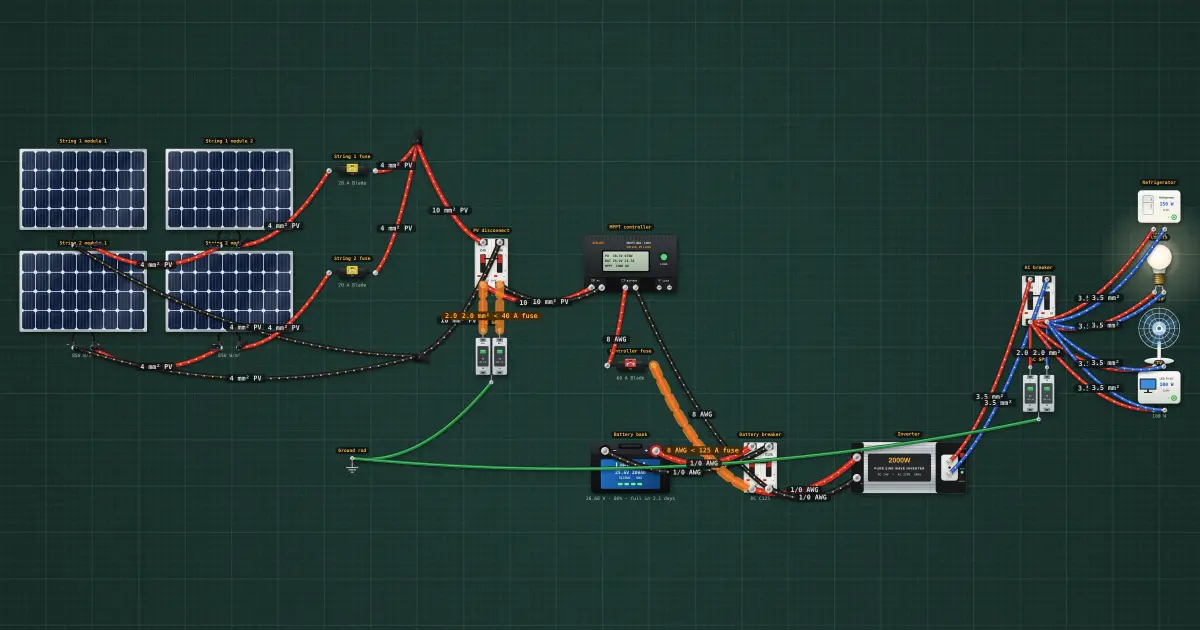
Open it in the simulator ▸All solar systems and builds
Other systems
Grid-tie solar system · Hybrid solar system · Off-grid inverter + ATS (budget hybrid) · AC-coupled solar with battery · 12 V solar for an RV, boat or small DIY · Three-phase grid-tie solar