Growatt SPF 5000 ES guide
An all-in-one: inverter, MPPT solar charger and a grid (AC) charger in one box. It powers the house from solar and the battery, and can use the grid as a backup input, but it does not export to the grid. It can also run without a battery.
Simulate this kind of system ▸Check my panels for this model
Key ratings
| Battery voltage | 48 V (lithium or lead-acid) |
|---|---|
| Rated output | 5,000 W, 230 V pure sine |
| Surge | 10,000 VA |
| Max PV array power | 6,000 W |
| MPPT operating range | 120–430 V |
| Max PV open-circuit voltage | 450 V |
| Max solar charge current | 100 A |
| AC charge current | 80 A |
| MPPT inputs | 1 |
| Max PV input current | about 18 A (listings differ: check the label) |
One MPPT input: put all the panels in one string, or two equal strings in parallel through a combiner if the current stays under the input limit.
Which system it builds
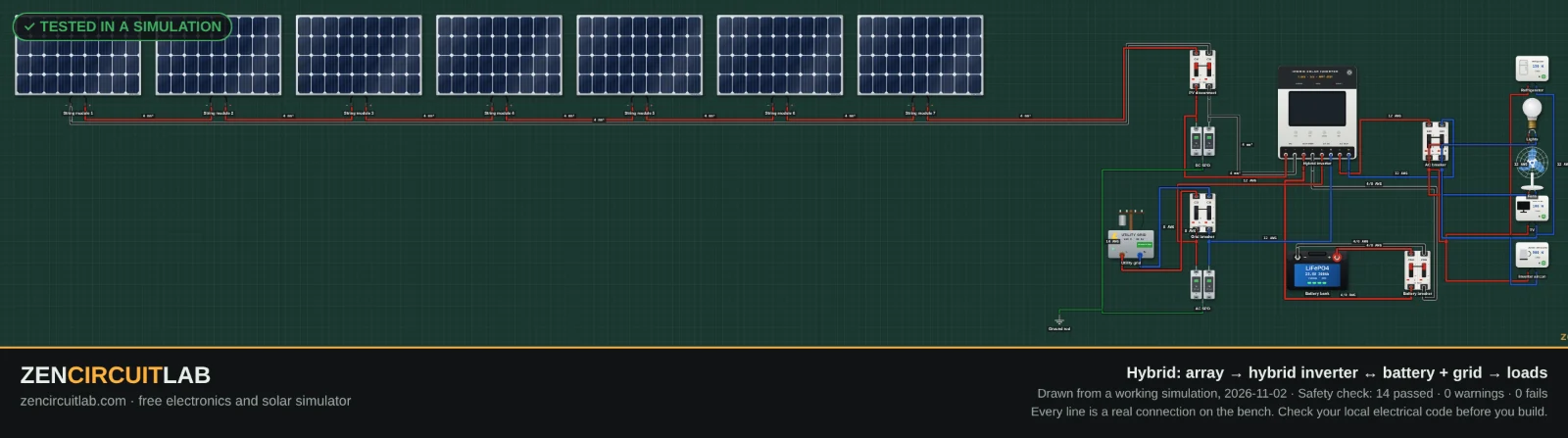
This unit is the heart of the lab's hybrid solar system: panels, the inverter, a battery and the loads, with the protection in between. In the simulator, set the inverter to 5,000 W and the battery to 48 V in the parts' settings.
How many panels in series
With a typical 550 W panel (Voc 49.9 V, Vmp 41.9 V, Isc 13.9 A, -0.27 %/°C):
- On a 15 °C morning (lowland tropics) each panel reaches 51.2 V: at most 8 in series under 450 V.
- On a −5 °C morning (cold climates) each reaches 53.9 V: at most 8 in series.
- On a hot roof (cells at 70 °C) Vmp falls to about 36.8 V per panel: at least 4 in series to stay above 120 V.
So: 4 to 8 panels per string in a warm climate. 8 in one string gives 4,400 W against the 6,000 W limit.
Open the string calculator with the Growatt SPF 5000 ES limits filled in →
Battery, fuse and cable
At full output (5,000 W) the inverter draws about 116 A from a 48 V battery. That calls for a fuse or DC breaker of about 150 A and heavy cable, kept short. See the battery bank calculator for the battery size and the inverter size calculator for what the loads need.
Wiring order
- Mount the unit on a non-flammable wall with the clearances in the manual, close to the battery (short battery cables).
- Battery first, with every breaker open: a 48 V battery, a DC breaker or fuse of about 150 A in the positive cable (full output is about 116 A at 48 V), and the cable size the manual gives for that current. Check polarity twice: reversed battery cables destroy most inverters.
- AC output to the house's backup circuits through its own breaker, then the grid input (if you use one) through another. Never connect the AC output to the grid.
- Panels last, with the PV isolator open: measure the string's open-circuit voltage with a meter before closing it, and compare it with the limit above.
- Power up in order: battery breaker, then the inverter, then the PV isolator, then the grid input. Set the battery type before the first charge.
Settings to check
- Battery type and voltages. A 16-cell (48 V) LiFePO4 pack typically uses 56.0–56.8 V absorption and 54.0 V float; use your battery maker's values, or BMS communication if the battery supports it.
- Output priority: solar first, then battery, then grid (often called SBU or "solar first") for the most solar use; grid-first for the longest battery life.
- Charge source priority and the AC charge current: limit it so the grid charger does not trip the house breaker.
- Low-battery cut-off and the voltage to return to the grid: keep LiFePO4 above about 10–20 % for long life.
⚠ This is a design aid to learn from and plan with, not the maker's instructions. Read the manual, follow your local electrical code, and have mains and battery wiring checked by a qualified electrician.
Questions
How many solar panels can I connect to the Growatt SPF 5000 ES?
With 550 W panels, 4 to 8 in series per string in a warm climate (fewer where it freezes), up to about 6,000 W in all. Check your own panel's Voc with the string calculator.
What battery does the Growatt SPF 5000 ES need?
A 48 V battery. Lithium (LiFePO4) lasts far longer than lead-acid; size it from what you use at night with the battery bank calculator.
Is this an official guide?
No. It is an independent guide by Zen Circuit Lab, worked out from the published specifications (sources below). Ratings can change between hardware versions: the label on your unit and its manual always win.
Sources
Other guides
Deye SUN-5K-SG03LP1 · Luxpower SNA 5000 · PowMr POW-HVM3.2H-24V-N (3 kW 24 V) · Victron SmartSolar MPPT 100/30 · All model guides