Piso Wi-Fi on solar: how big a panel and battery for a router and coin box
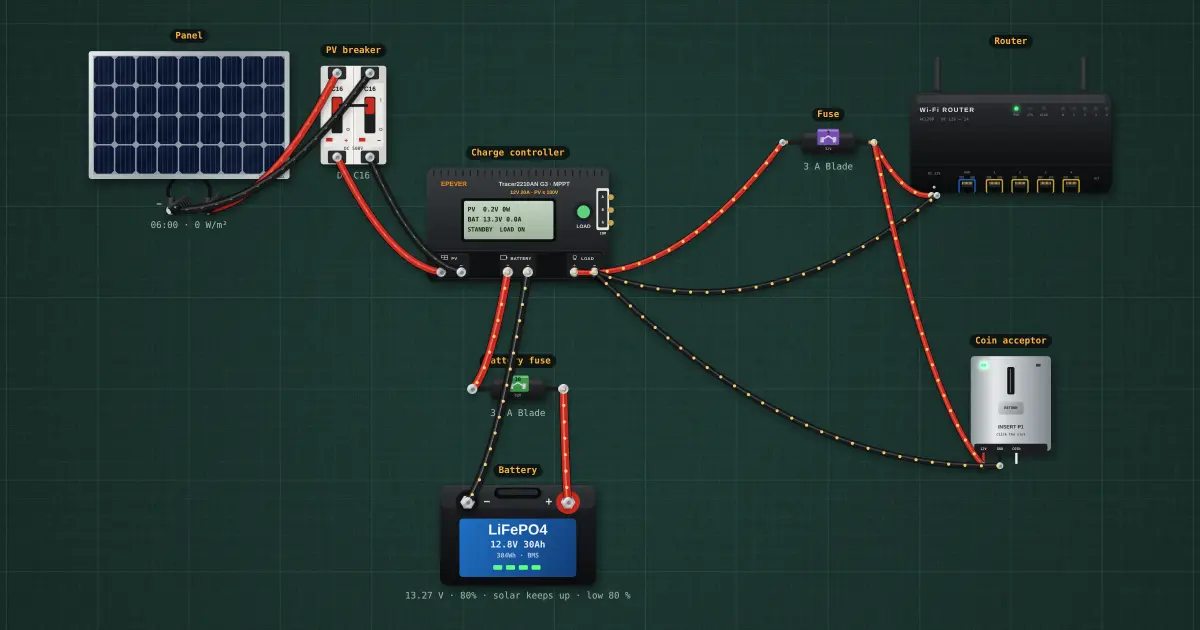
100 W panel, a 10 A MPPT charge controller, a 12 V 30 Ah LiFePO4 battery and the box: router plus coin acceptor on the controller’s load terminals. The panel shows the battery current and the hours left. A piso Wi-Fi box is a small, steady 12 V load: a router at 4–7 W and a coin acceptor under 1 W idle. That is about 0.4 A, or 10 Ah a day. A 100 W panel makes 300–400 Wh on a Cebu day, three times what the box uses, and a 12 V 30 Ah LiFePO4 battery carries two cloudy days. The bench runs a day of sun so you can watch the charge and the night.
Build it in the labGuided build, test sheet and fault finding, free in your browser.
Parts list
Test procedure
Each test has an expected value and a pass range, like a factory test sheet:
- Box draw (router + coin acceptor idle)
- Morning sun: the panel charges the battery and runs the box
- Night: the battery carries the box
- A 12 Ah battery instead
How it works
What it does: 100 W panel, a 10 A MPPT charge controller, a 12 V 30 Ah LiFePO4 battery and the box: router plus coin acceptor on the controller’s load terminals. The panel shows the battery current and the hours left.
Build it (guided or ready-made), then run its test procedure below. Every test has an expected value and a pass range, just like a factory test sheet.
Background
Solar piso wifi: the box is cheap to run; the sizing is about cloudy days, not sunny ones. (This is the generic sizing exercise, not a vending design.)