Solar charge controller
EPEVER Tracer 3210AN · MPPT 30 A · 12/24 V auto · PV max 100 V Voc · load output 30 A · LiFePO4 (LFP4S)
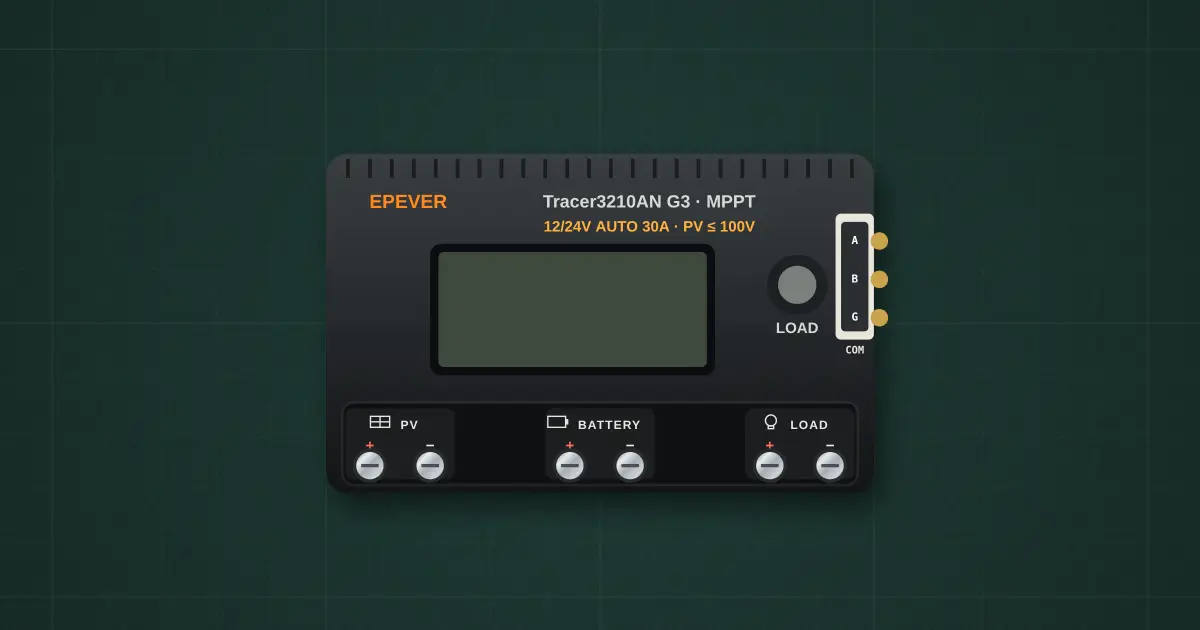
Try it on the benchThe lab drops it on an empty bench and opens its datasheet card.
Typical part: Solar charge controller (EPEVER, Renogy, Victron models)
Pins
- PV+
- PV−
- BAT+
- BAT−
- LOAD+
- LOAD−
- COM A (RS-485 +, RJ45 pins 5/6)
- COM B (RS-485 −, RJ45 pins 3/4)
- COM GND (RJ45 pins 7/8)
Ratings and limits
| Battery | 12 / 24 V, auto-detect at power-up (battery range 8–32 V) |
|---|---|
| Rated charge current | 30 A |
| Max PV open-circuit voltage | 100 V at minimum temperature (92 V at 25 °C) |
| Rated charging power | 390 W @ 12 V, 780 W @ 24 V |
| Start-up | MPP range Vbat + 2 V to 72 V |
| Load output | 30 A, LVD / LVR per battery setting, overload cut-off with retries |
| Self-consumption | 8 mA @ 12 V, 5 mA @ 24 V |
| Peak efficiency | 98 % |
| Reverse polarity | PV: blocked, no damage. Battery: survived only with PV disconnected |
| COM port (EPEVER) | RS-485 Modbus RTU, 115200 8N1, slave id 1 by default. Input registers 0x3100 PV V, 0x3101 PV A, 0x3104 battery V, 0x3105 charge A, 0x310C/0x310D load V/A, 0x311A SoC %, 0x3200 battery status; holding 0x9000–0x900E battery settings; coil 0x0002 load on/off |
How to use it
Connect the battery first (it powers the controller and sets the system voltage), then the PV; disconnect in reverse. Fuse the battery cable close to the battery. Size the string so its cold Voc stays under the PV maximum — panels in series add their Voc. MPPT controllers convert a high string voltage down to battery voltage; PWM ones need panels matched to the battery (36-cell for 12 V).
Lessons and builds that use it
- Send an SMS with the A7670 LTE module
- Capstone: solar-powered GPS tracker
- 14. Solar: the light runs off-grid (build)
- Piso Wi-Fi on solar: how big a panel and battery for a router and coin box (build)
- A string against the controller: the cold-morning Voc
- PWM against MPPT: the harvest, as a number
- Exam: this system fails on cold mornings