PWM against MPPT: the harvest, as a number
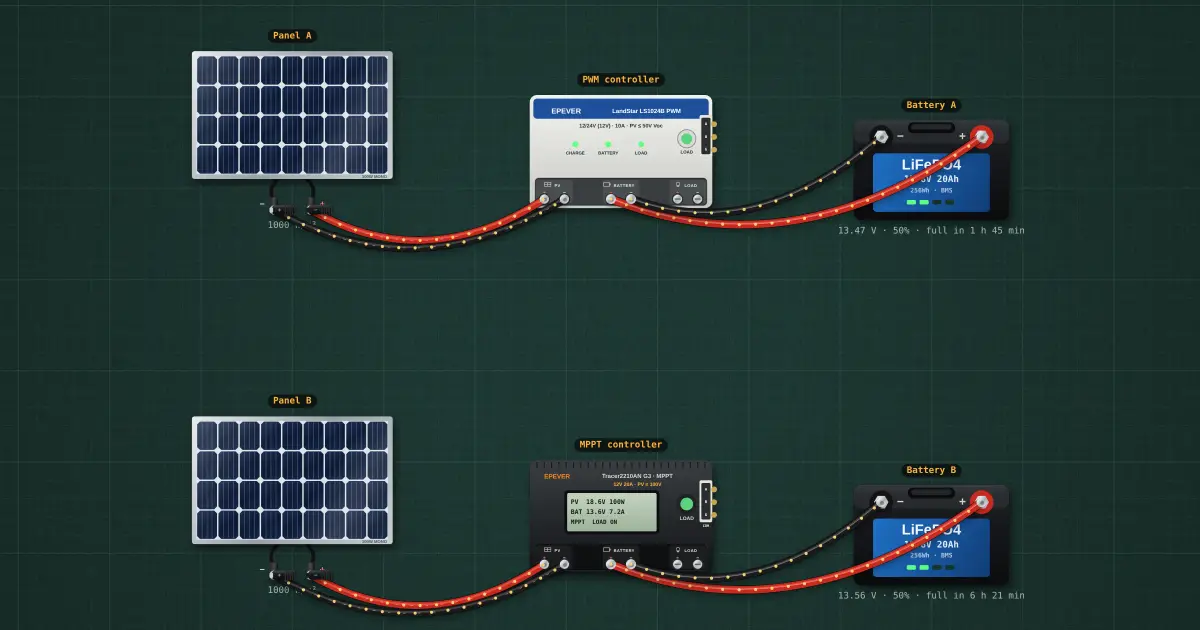
A PWM controller is a switch: it connects the panel straight to the battery, so the panel runs at battery voltage (about 13 V) instead of its 18 V knee, and the difference is thrown away. An MPPT runs the panel at the knee and converts down. Two identical panels, two identical batteries, two controllers: the Wh counters tell the story, and it is biggest on cold mornings and with high-voltage panels.
Open this lesson in the labFree, in your browser, no account needed.
How it works
PWM: the panel sits at 0.0 V giving 0 W. MPPT: the panel sits at 0.0 V giving 0 W. Harvested so far: 0.0 Wh against 0.0 Wh.
The gap is (Vmp − Vbatt) × I: it grows when the battery is low (lower voltage), when the panel is cold (higher Vmp), and with a 72-cell panel on a 12 V battery, where PWM throws away more than half.
Try it on the bench
- Let it run a few minutes at this speed and compare the two Wh counters.
- Swap both panels for the 400 W 72-cell: PWM now holds a 41 V knee at 13 V and loses most of it.
- Turn the weather on at 10 °C: Vmp rises and the MPPT’s lead grows.
Parts on the bench
In the course
Solar PV Systems, module “6 · Charge controllers: PWM and MPPT”.
More on solar pv physics
- The IV curve: Voc, Isc and the knee
- Cold mornings raise Voc; hot noons cut power
- Shading and bypass diodes: a shadow costs more than its size
- A string against the controller: the cold-morning Voc
- Lead-acid against LiFePO4: usable capacity, voltage and life
- Wiring, fuses and breakers for an array: the 1.25 and 1.56 rules
- Grounding, bonding and surge protection: the two jobs of earth
- Commissioning and troubleshooting: the checklist and the fault