Grounding, bonding and surge protection: the two jobs of earth
Earth has two jobs in a solar system. Bonding: every metal frame, rail and enclosure is joined to one equipment ground, so a live wire touching a frame trips the protection instead of waiting for a hand. Reference: the system is tied to the earth at one electrode, so the surge protectors have somewhere to dump a lightning strike. A surge protective device without a short, fat lead to that electrode is a decoration. The Philippines has among the highest lightning densities on earth: an SPD at the array input and one at the AC panel is where a nearby strike ends instead of in the controller.
Open this lesson in the labFree, in your browser, no account needed.
How it works
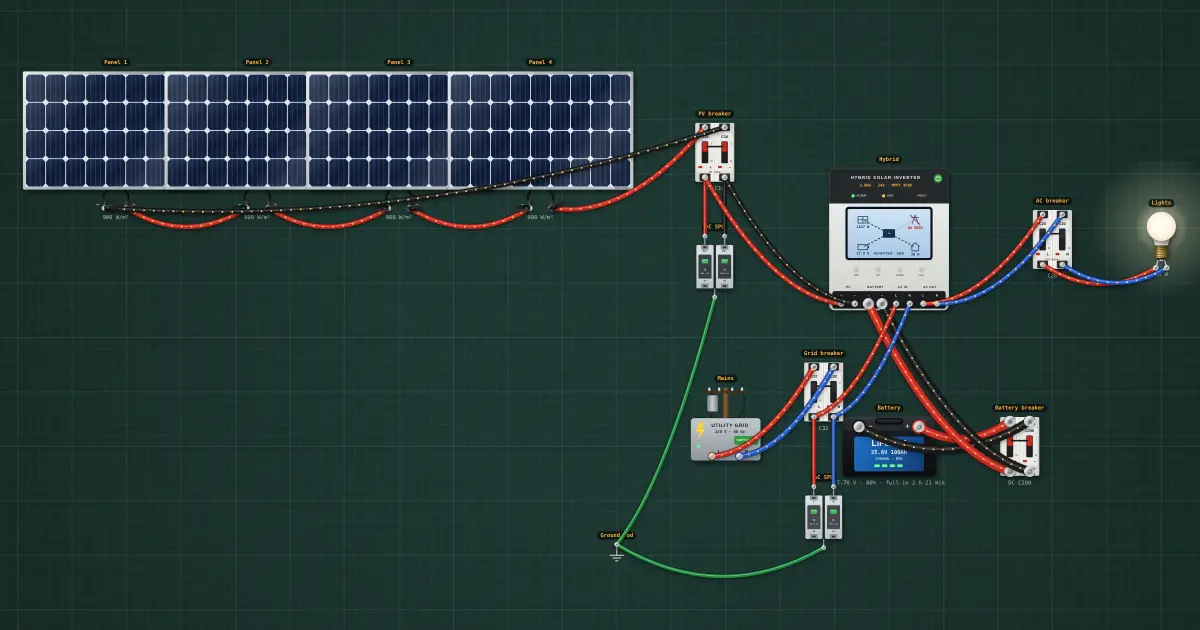
On this bench the DC SPD sits across the array at the PV breaker and the AC SPD across the grid connection; the ground rod is the electrode. The bench cannot draw the bonding jumper along the frames, so the safety check reports F1 (bonding) as information, F2 (surge protection on each side) and F3 (an electrode) as pass or fail.
Delete the AC SPD and run the 🛡 Safety check: F2 says which side is bare. Delete the ground rod: F3. Then put them back.
Sizes: the equipment-grounding conductor follows the circuit’s breaker (PEC 2017 Art. 2.50, NEC 250.122: 5.5 mm² (10 AWG) for up to 60 A); the electrode conductor is bare copper to a 2.4 m rod; SPD leads as short and straight as the box allows.
Try it on the bench
- Delete the DC SPD and run the safety check: F2 names the DC side.
- Delete the ground rod: F3 fails, and the SPDs have nothing to work against.
- Delete only the green PE wire of one SPD: F2b says its PE floats; the module is a decoration until it is earthed.
Parts on the bench
- 4 × Solar panel
- 2 × DC breaker
- 2 × Surge protector (SPD)
- Hybrid solar inverter
- LiFePO4 battery
- Utility grid
- 2 × AC breaker
- 220 V bulb
- Ground symbol
In the course
Solar PV Systems, module “10 · Grounding, bonding and surge protection”.
More on solar pv physics
- The IV curve: Voc, Isc and the knee
- Cold mornings raise Voc; hot noons cut power
- Shading and bypass diodes: a shadow costs more than its size
- A string against the controller: the cold-morning Voc
- PWM against MPPT: the harvest, as a number
- Lead-acid against LiFePO4: usable capacity, voltage and life
- Wiring, fuses and breakers for an array: the 1.25 and 1.56 rules
- Commissioning and troubleshooting: the checklist and the fault