Shading and bypass diodes: a shadow costs more than its size
A module is three substrings in series, each behind a bypass diode. Shade one third and it cannot carry the string current, so its diode takes over: the module loses that third’s voltage, the IV curve gets a step and the PV curve a second peak, and the shaded cells run hot. A hand-sized shadow on one cell can cost a third of the module.
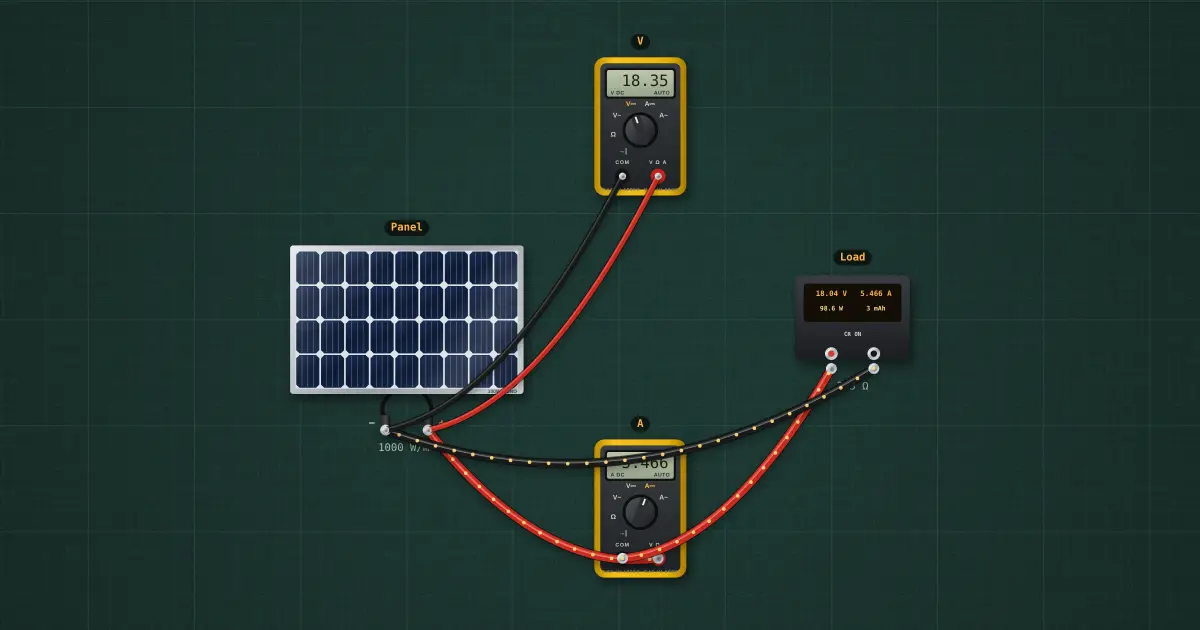
Open this lesson in the labFree, in your browser, no account needed.
How it works
No shade. Possible power now 0 W of 100 W; running at 0 W.
Open the IV / PV curve card and drag a shade slider in the panel’s inspector: the step appears in the current curve and the power curve grows a second hump. An MPPT can land on the wrong hump.
Try it on the bench
- Shade third 1 to 80 %: the possible power falls by about a third, not by 27 % (80 % of a third).
- Shade all three lightly (20 % each): no bypass, power falls only 20 %. Even shade is cheap; a dense shadow on one cell is expensive.
- Raise the load to 10 Ω with one third shaded: the panel sits on the lower hump of the PV curve.
Parts on the bench
- Solar panel
- Electronic load
- 2 × Digital multimeter
In the course
Solar PV Systems, module “5 · Shading, bypass and blocking diodes”.
More on solar pv physics
- The IV curve: Voc, Isc and the knee
- Cold mornings raise Voc; hot noons cut power
- A string against the controller: the cold-morning Voc
- PWM against MPPT: the harvest, as a number
- Lead-acid against LiFePO4: usable capacity, voltage and life
- Wiring, fuses and breakers for an array: the 1.25 and 1.56 rules
- Grounding, bonding and surge protection: the two jobs of earth
- Commissioning and troubleshooting: the checklist and the fault