Lead-acid against LiFePO4: usable capacity, voltage and life
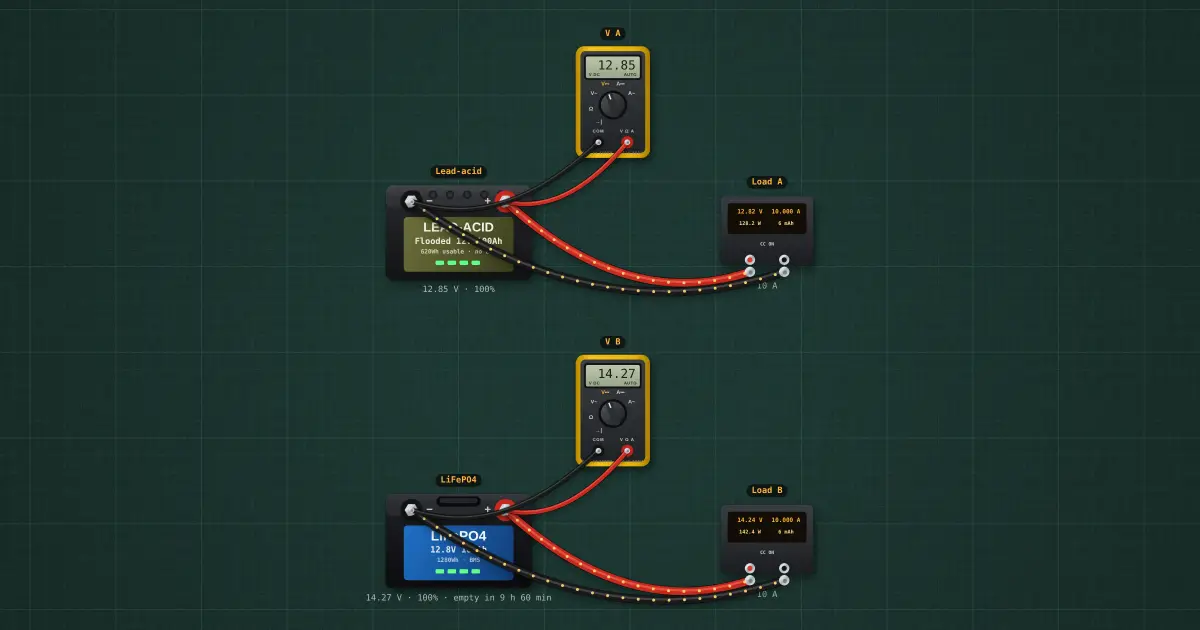
Two 100 Ah batteries on the same 10 A load. The lead-acid is at 12.0 V and half empty after five hours, where it should stop; the LiFePO4 holds 13 V and goes on for eight. Peukert takes more from the lead-acid at high current, and every hour it spends below half charge costs it capacity. Lead-acid still wins on price and on standby duty; this lesson shows the price of that price.
Open this lesson in the labFree, in your browser, no account needed.
How it works
Lead-acid: 100 % at 0.00 V, Peukert factor ×1.00 at 10 A (C/10). LiFePO4: 100 % at 0.00 V. Usable: about 50 Ah against 80–90 Ah from the same nameplate, which is why a lead-acid bank is sized at twice the Ah.
Open the lead-acid's datasheet card for the full comparison, including where it still makes sense.
Try it on the bench
- Run at this speed: the lead-acid reaches 50 % in about five hours of battery time; stop there in real life.
- Raise both loads to 30 A: Peukert makes the lead-acid lose capacity faster than the current alone explains.
- Select the lead-acid and set it to AGM or gel: a different gassing voltage, which the charge controller must respect.
Parts on the bench
- Lead-acid battery
- 2 × Electronic load
- 2 × Digital multimeter
- LiFePO4 battery
In the course
Solar PV Systems, module “7 · Batteries and charging”.
More on solar pv physics
- The IV curve: Voc, Isc and the knee
- Cold mornings raise Voc; hot noons cut power
- Shading and bypass diodes: a shadow costs more than its size
- A string against the controller: the cold-morning Voc
- PWM against MPPT: the harvest, as a number
- Wiring, fuses and breakers for an array: the 1.25 and 1.56 rules
- Grounding, bonding and surge protection: the two jobs of earth
- Commissioning and troubleshooting: the checklist and the fault