Cold mornings raise Voc; hot noons cut power
Voltage comes from the cells’ temperature, not the sun: Voc falls about 0.3 % for every degree the cells warm, and in full sun they run 20–30 °C over the air. A 10 °C dawn gives the highest Voc a string will ever show, and that is the number a controller must survive. A 35 °C noon gives cells near 60 °C and a tenth less power than the datasheet.
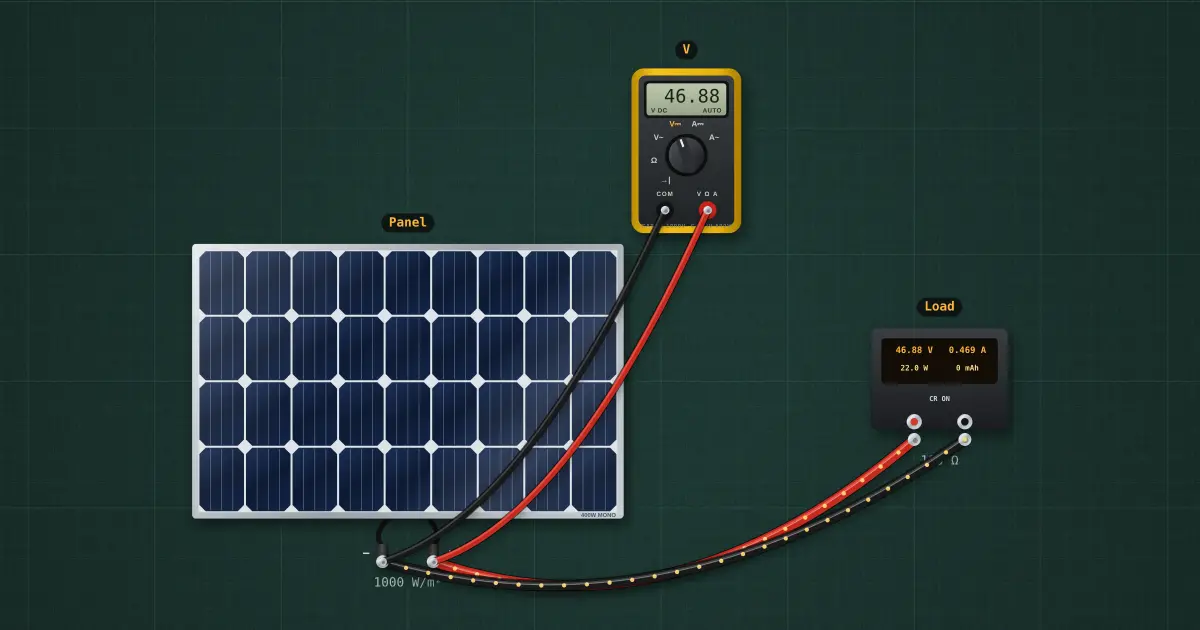
Open this lesson in the labFree, in your browser, no account needed.
How it works
Ambient 10 °C, full sun: cells at 25 °C (NOCT 45 °C puts them (45 − 20)/800 × G over the air). Voc = 49.5 V × (1 + -0.3/100 × (25 − 25)) = 0.0 V; Pmax = 400 W × (1 + -0.4/100 × ΔT) ≈ 0 W.
Change the ambient in ⚙ settings (site conditions) and watch Voc move the other way from the temperature. The record-low field is what the string sizing uses.
Try it on the bench
- ⚙ settings → ambient 35 °C: cells near 60 °C, Voc drops about 5 V, power about 50 W.
- Ambient 0 °C (a Baguio dawn): Voc climbs past 52 V. Five of these in series would exceed 260 V.
- Turn the weather off: everything returns to the datasheet’s 25 °C.
Parts on the bench
- Solar panel
- Electronic load
- Digital multimeter
In the course
Solar PV Systems, module “3 · Irradiance and temperature”.
More on solar pv physics
- The IV curve: Voc, Isc and the knee
- Shading and bypass diodes: a shadow costs more than its size
- A string against the controller: the cold-morning Voc
- PWM against MPPT: the harvest, as a number
- Lead-acid against LiFePO4: usable capacity, voltage and life
- Wiring, fuses and breakers for an array: the 1.25 and 1.56 rules
- Grounding, bonding and surge protection: the two jobs of earth
- Commissioning and troubleshooting: the checklist and the fault