Wiring, fuses and breakers for an array: the 1.25 and 1.56 rules
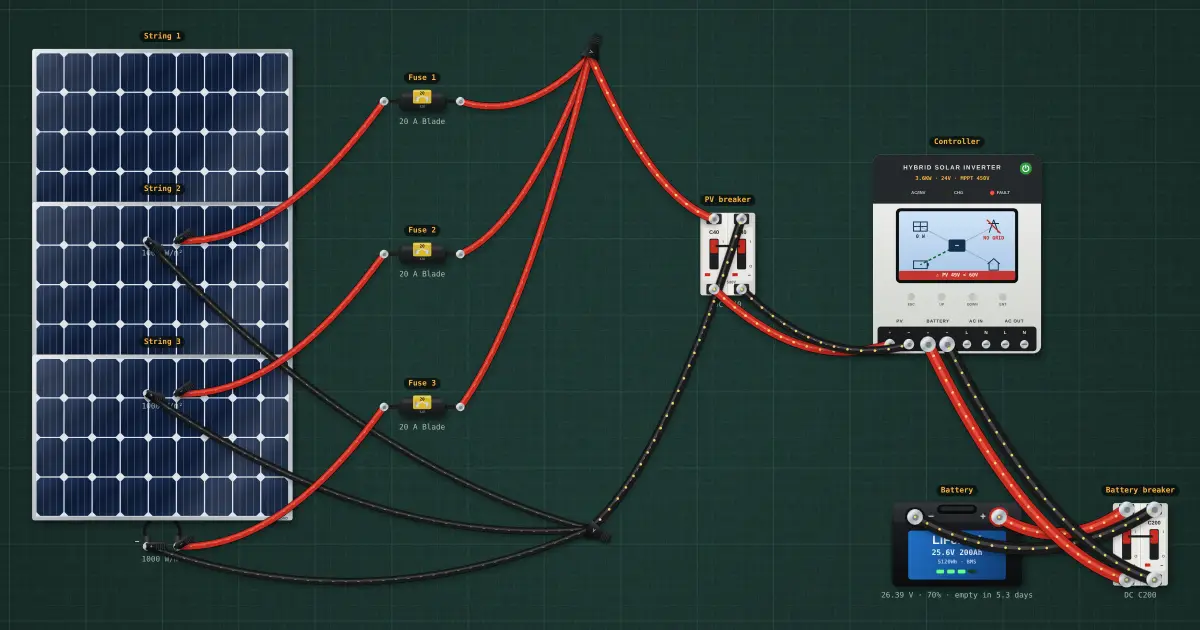
A PV conductor carries current for hours, and on an edge-of-cloud morning more than the datasheet’s Isc. So the circuit is rated at 125 % of Isc, and the conductor at 125 % of that again: 1.56 × Isc. With three or more strings in parallel each string gets its own fuse, because a fault in one is fed by all the others. The battery side has the opposite problem: a battery can push thousands of amps into a short, so the fuse sits within 450 mm of it and is never bigger than the cable it protects.
Open this lesson in the labFree, in your browser, no account needed.
How it works
Three strings of one 400 W module: Isc 10.3 A each, 30.9 A together. The combiner conductor must carry 1.56 × 30.9 = 48.2 A: 10 mm² PV cable (98 A) does; 4 mm² (55 A) does too, with less margin. Each string fuse is between 1.56 × 10.3 = 16.1 A and the module’s 15–20 A series-fuse rating: 20 A. The battery breaker is sized for the hybrid’s 160 A at 24 V and no bigger than the 4/0 cable’s 260 A.
Run the 🛡 Safety check: B2, B3 and B4 read these very numbers. Then take one string fuse out and run it again.
Try it on the bench
- Change the combiner cable to 2.5 mm² PV (select it): B2 fails at 1.25 × Isc.
- Set the battery breaker to 300 A: bigger than the cable, B4 fails: the cable would burn before it trips.
- Delete one string fuse: B3 fails for the three parallel strings.
Parts on the bench
In the course
Solar PV Systems, module “4 · Array configuration and the string window”.
More on solar pv physics
- The IV curve: Voc, Isc and the knee
- Cold mornings raise Voc; hot noons cut power
- Shading and bypass diodes: a shadow costs more than its size
- A string against the controller: the cold-morning Voc
- PWM against MPPT: the harvest, as a number
- Lead-acid against LiFePO4: usable capacity, voltage and life
- Grounding, bonding and surge protection: the two jobs of earth
- Commissioning and troubleshooting: the checklist and the fault