The IV curve: Voc, Isc and the knee
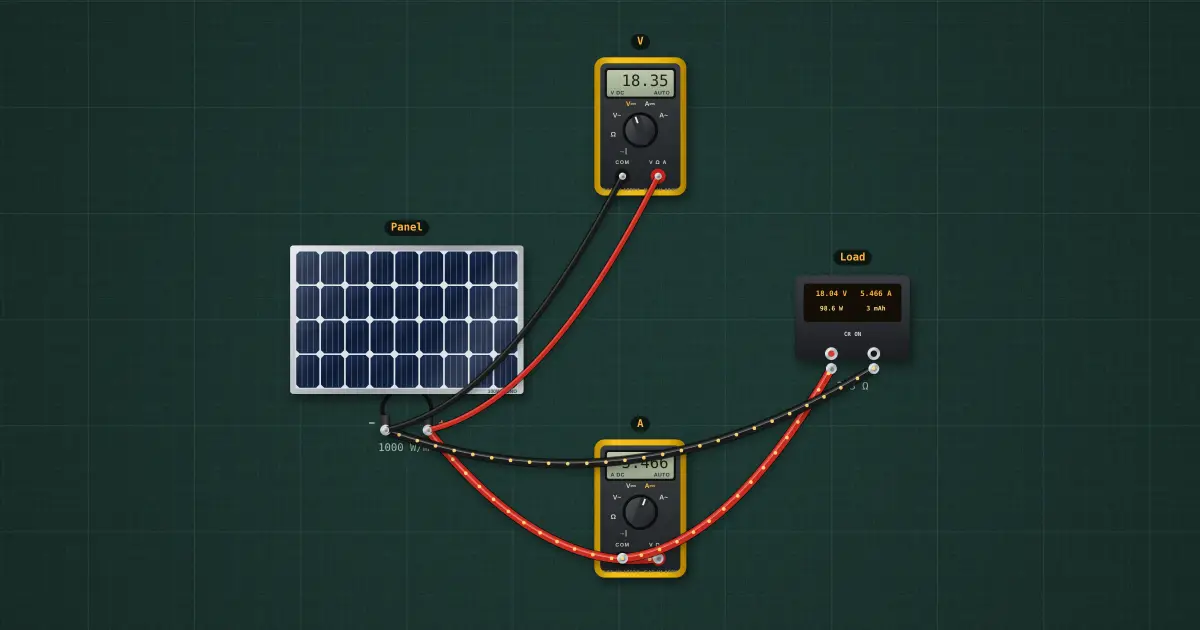
A panel is not a voltage source. Open, it shows Voc and gives nothing; shorted, it gives Isc and no volts; the power is at the knee, Vmp × Imp. Sweep the load and the operating point slides along the curve.
Open this lesson in the labFree, in your browser, no account needed.
How it works
At 0 W/m² this module's curve has Voc 0.0 V, Isc 0.00 A and its knee at 0.0 V × 0.00 A = 0 W. It is running at 0.0 V, 0.00 A: 0 W.
Open the IV / PV curve card on the panel and drag the load's resistance: the dot slides along the curve. Only one resistance lands on the knee; that is the job an MPPT controller does by itself.
Try it on the bench
- Select the load and raise its resistance to 100 Ω: the voltage climbs to Voc and the power falls to almost nothing.
- Lower it to 0.5 Ω: the current is Isc and the power is tiny again.
- Set the panel to 500 W/m²: Isc halves, Voc barely moves.
- Switch to the 400 W panel: 72 cells, twice the voltage.
Parts on the bench
- Solar panel
- Electronic load
- 2 × Digital multimeter
In the course
Solar PV Systems, module “1 · PV basics”.
More on solar pv physics
- Cold mornings raise Voc; hot noons cut power
- Shading and bypass diodes: a shadow costs more than its size
- A string against the controller: the cold-morning Voc
- PWM against MPPT: the harvest, as a number
- Lead-acid against LiFePO4: usable capacity, voltage and life
- Wiring, fuses and breakers for an array: the 1.25 and 1.56 rules
- Grounding, bonding and surge protection: the two jobs of earth
- Commissioning and troubleshooting: the checklist and the fault