Real device: water heater, 220 V AC to hot water
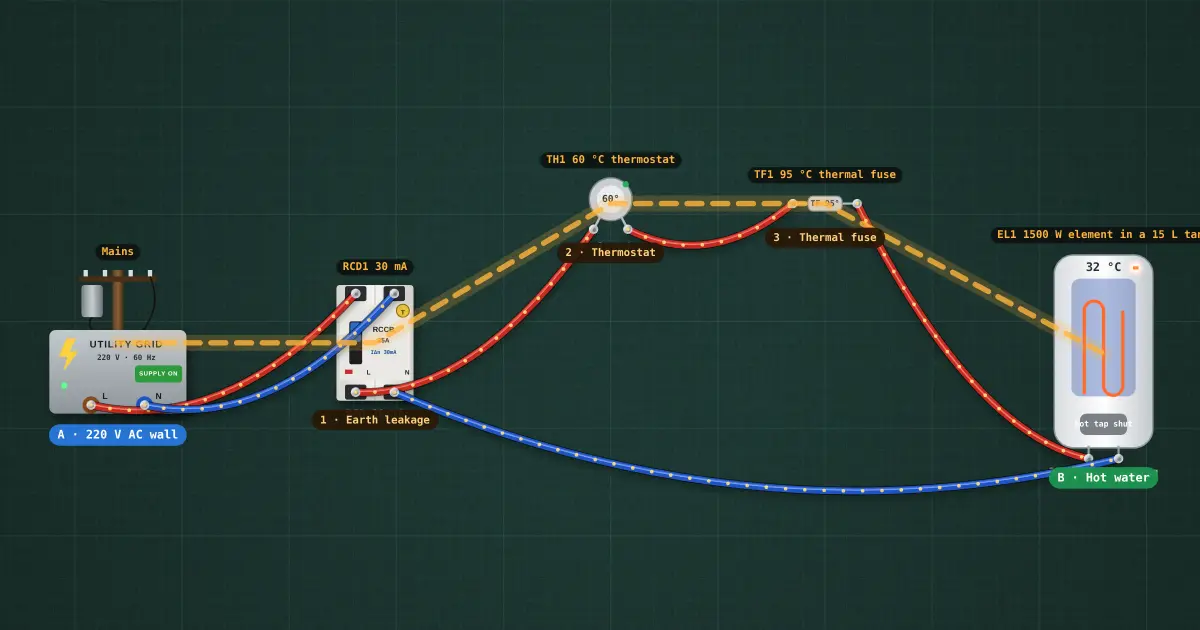
A 15 L storage water heater: an RCD, a bimetal thermostat, a one-shot thermal fuse and a 1500 W sheathed element. The heat is the output.
Build it in the labGuided build, test sheet and fault finding, free in your browser.
Parts list
Test procedure
Each test has an expected value and a pass range, like a factory test sheet:
- Element draws its rating
- Thermostat stops it at 60 °C
- Welded thermostat: the thermal fuse opens below boiling
- Dry tank: the thermal fuse opens before the element burns
How it works
In everything else in this lab heat is waste. Here it is the product: the element is designed to turn all 1500 W into heat, so the Thermal view labels it "designed to heat" instead of flagging it. The engineering is all in stopping safely: one thing regulates, a second thing of a different kind stops it if the first fails, and a third watches for current going where it shouldn't.
A220 V AC at the wall.BWater at 60 °C in the tank.
The path, A to B
- 220 V AC wall (Mains). Point A: the wall, 220 V at 60 Hz.
- Earth leakage (RCD1). Leakage protection. Water and 220 V share this tank. If the element's sheath cracks, current escapes into the water and the earthed tank instead of returning on neutral; the RCD sees line and neutral no longer match and opens within 40 ms at 30 mA, below the current that can stop a heart.
- Thermostat (TH1). Regulation. A bimetal snap disc clipped to the tank opens at 60 °C and closes again near 54 °C. That is the whole control system: on, off, on, many thousands of times over its life.
- Thermal fuse (TF1). The last resort, of a different kind. A thermostat's contacts arc every time they break 7 A, and one day they may weld shut. Then the water keeps heating. At 95 °C, before the water boils and the pressure climbs, this fuse melts and opens for good. Try it: weld TH1's contacts in its inspector.
- Hot water (EL1). Point B: the heating element and the water. A nichrome coil packed in magnesium-oxide powder inside a metal sheath: the powder carries heat out but no current, so the water touches a cool, earthed tube, not a live wire. 32 Ω at 220 V is 1500 W, all of it heat, by design.
Every other part, and why
Why it lasts
- Two temperature limits that fail in different ways. The thermostat is mechanical and resettable; the thermal fuse is a one-shot pellet. Something that defeats one (welded contacts) does not defeat the other.
- The fuse is set below boiling (95 °C), so even the worst case never makes steam inside a closed tank.
- The RCD covers the fault no thermostat can see: current leaking out of the element into the water.
- The element is just a resistor in an insulated sheath: nothing to drift, nothing to wear but the thermostat's contacts. Kept under water, its sheath runs only about 30 °C hotter than the water. Running it dry (empty the tank in the inspector) is how elements die; the thermal fuse, clipped near the element, catches that too.
- Real tanks add a magnesium rod (sacrificial anode) that corrodes instead of the tank. Replace it every few years and the tank outlives the house's pipes.
On the mat: the amber line is the energy path from A to B. Click any part: why it is there shows at the top of the inspector. Turn the path off or on in the View menu (Real-device path & notes); the Thermal view shows where the heat goes.
Background
The bimetal thermostat (from John Harrison's 18th-century clock compensation) and the sheathed element (Calrod, 1920s) are the whole technology of electric water heating. A heater from the 1960s and a new one are wired the same way.