Stepper dial: a pot sets the angle
The motor shaft follows the pot, like a remote dial. A stepper moves in fixed steps, so the sketch always knows where it is without a sensor: it counts. A NEMA 17 takes 200 steps a turn (1.8° each). Its two coils need their current reversed in turn, so each gets an H-bridge: the L298N has two, switched by IN1–IN4. The sketch turns the pot reading into a target step, moves one step every 30 ms until it gets there, and switches the bridges off half a second later to stop the coils heating. This bench runs at half speed, so the simulator sees every step. On the real thing: use a 12 V, about 0.4 A NEMA 17 (around 30 Ω a coil), like the one here. Most NEMA 17s sold are 1.5–2 A, 1–3 Ω motors: on an L298N at 12 V they draw far more than either is rated for, so use an A4988 or DRV8825 driver with its current limit set; the same sketch drives one with STEP and DIR instead of four pins.
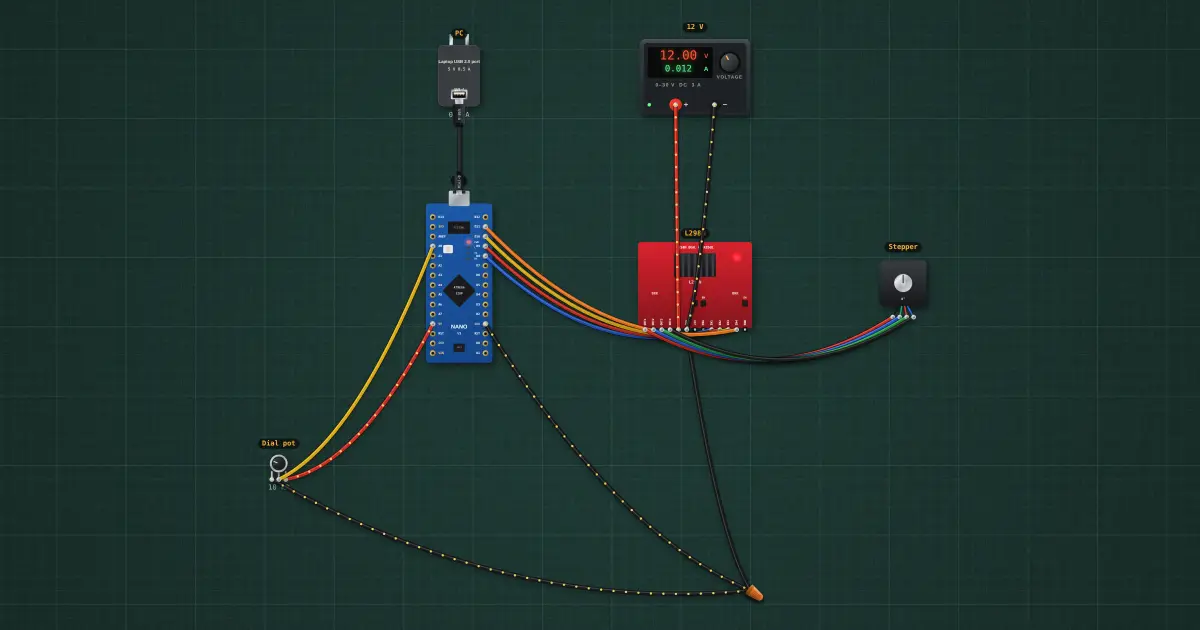
Build it in the labGuided build, test sheet and fault finding, free in your browser.
Parts list
- Arduino Nano
- USB charger / port
- Potentiometer
- Bench power supply
- L298N motor driver
- Stepper motor (bipolar)
Test procedure
Each test has an expected value and a pass range, like a factory test sheet:
- Follows the pot
- Turns the other way too
- Where you put it, within 6°
How it works
What it does: The motor shaft follows the pot, like a remote dial.
Build it (guided or ready-made), then run its test procedure below. Every test has an expected value and a pass range, just like a factory test sheet.
Things to try
- Turn the pot fast: the motor follows at its own pace, 10 RPM.
- Watch the coil current drop to zero half a second after it stops: without that, the L298N and the motor run warm all the time.
- The L298N loses about 2 V in its transistors; a DRV8825 or A4988 driver loses almost nothing and adds microstepping for smooth motion.
Background
Gauges, camera focus, 3D-printer axes and telescope mounts are steppers counting steps.