Arduino Nano (ATmega328P, FT232RL)
Arduino Nano · ATmega328P 16 MHz, 5 V logic · 32 KB flash (2 KB bootloader), 2 KB SRAM, 1 KB EEPROM · 14 digital I/O + 8 analog in (A6/A7 analog only) · PWM on 3, 5, 6, 9, 10, 11 · VIN 7–12 V (6–20 V limits) · 20 mA per pin (40 mA absolute max) · FT232RL USB-serial
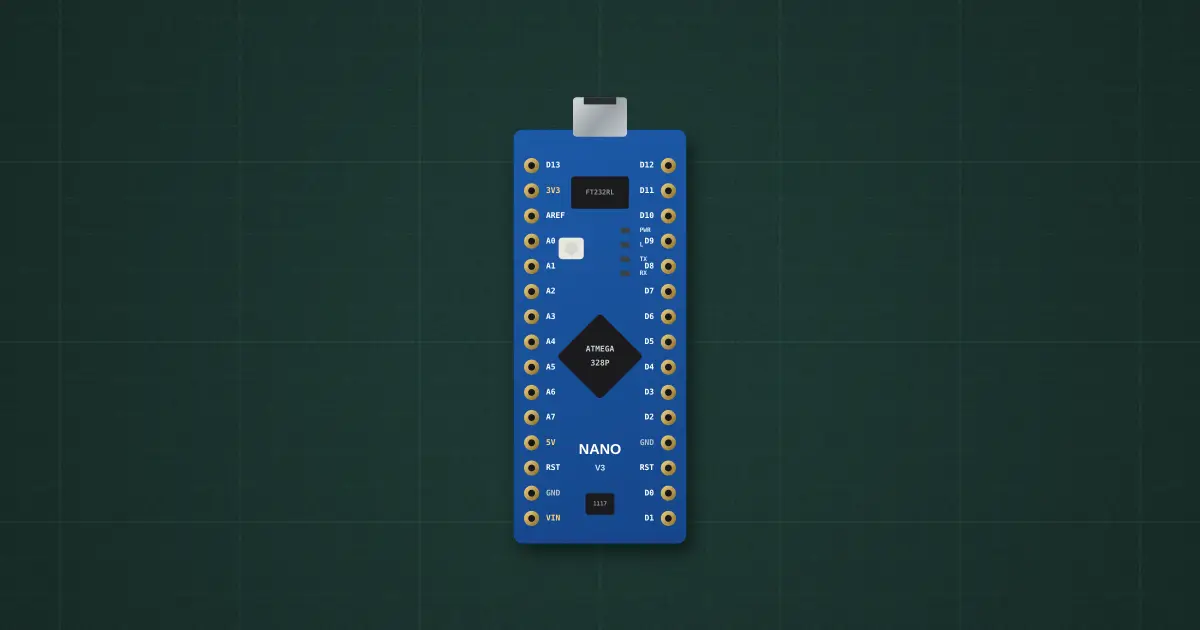
Try it on the benchThe lab drops it on an empty bench and opens its datasheet card.
Typical part: Arduino Nano (A000005) · ATmega328P + FT232RL (CH340G on most clones)
Pins
- D13
- 3V3
- AREF
- A0
- A1
- A2
- A3
- A4 (SDA)
- A5 (SCL)
- A6 (analog only)
- A7 (analog only)
- 5V
- RST
- GND
- VIN
- D12
- D11 ~
- D10 ~
- D9 ~
- D8
- D7
- D6 ~
- D5 ~
- D4
- D3 ~ (INT1)
- D2 (INT0)
- GND
- RST
- D0 RX0
- D1 TX1
- Mini-USB port
Ratings and limits
| Operating voltage | 5 V |
|---|---|
| Input voltage | 7–12 V recommended on VIN (pin 30), 6–20 V limits |
| USB | Mini-B, through a Schottky diode (the 5 V rail sits near 4.7 V on USB) |
| Current per I/O pin | 20 mA recommended, 40 mA absolute maximum |
| 3V3 pin | about 50 mA (from the USB-serial chip) |
| Flash / SRAM / EEPROM | 32 KB (2 KB bootloader) / 2 KB / 1 KB |
| Clock | 16 MHz |
| PWM | pins 3, 5, 6, 9, 10, 11 |
| ADC | 8 inputs, 10-bit; A6 and A7 are analog only |
| Size | 45 × 18 mm, breadboard friendly |
How to use it
The same chip as the Uno on a breadboard-friendly board. Many clones use the CH340G USB chip and the old bootloader: if uploads fail with “not in sync”, choose Processor → ATmega328P (Old Bootloader).