Orange Pi One
Orange Pi One · Allwinner H3 quad Cortex-A7 1.2 GHz, Mali-400 MP2 · 512 MB DDR3 · boots from microSD (Armbian 23.11 (Linux 6.1) image) · 10/100 Ethernet · USB 2.0 host + micro-USB OTG (data only) · 40-pin header, 3.3 V logic · 5 V 2 A on a 4.0 × 1.7 mm jack · about 1.3 W idle, up to 5 W busy
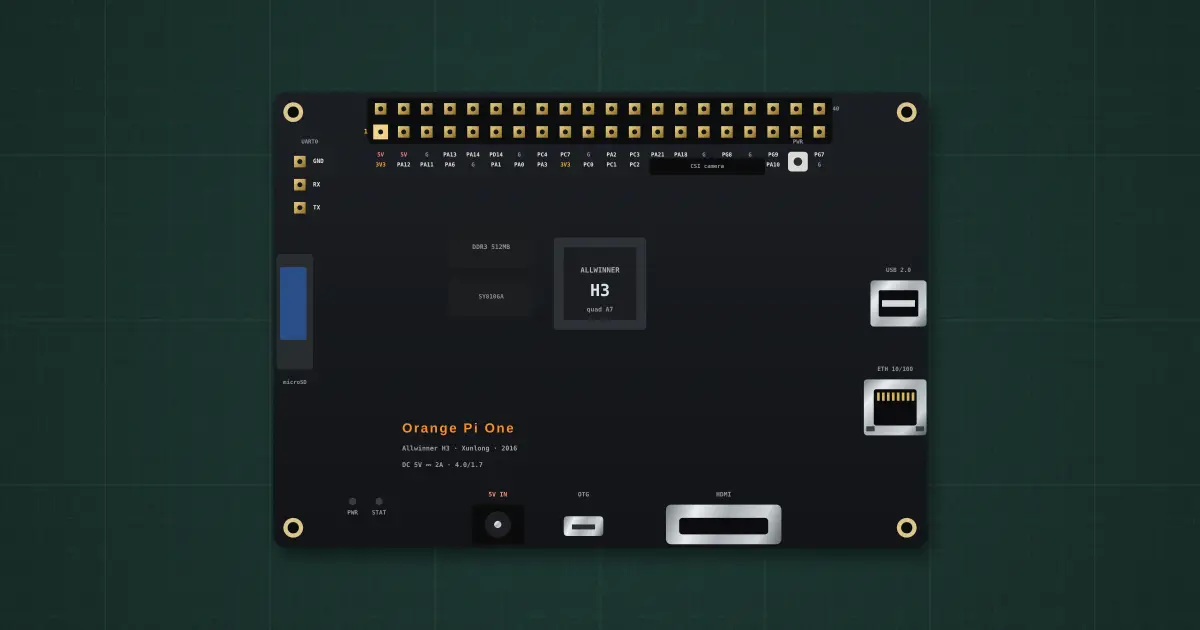
Try it on the benchThe lab drops it on an empty bench and opens its datasheet card.
Typical part: Xunlong Orange Pi One (Allwinner H3)
Pins
- 5V (pin 2)
- GND (pin 6)
- PA7 · coin input (lab) (pin 29)
- Ethernet (10/100, RJ45)
- 3.3V (pin 1)
- PA12 · TWI0 SDA (pin 3)
- 5V (pin 4)
- PA11 · TWI0 SCK (pin 5)
- PA6 · PWM1 (pin 7)
- PA13 · UART3 TX / SPI1 CS (pin 8)
- GND (pin 9)
- PA14 · UART3 RX / SPI1 CLK (pin 10)
- PA1 · UART2 RX (pin 11)
- PD14 (pin 12)
- PA0 · UART2 TX (pin 13)
- GND (pin 14)
- PA3 · UART2 CTS (pin 15)
- PC4 (pin 16)
- 3.3V (pin 17)
- PC7 (pin 18)
- PC0 · SPI0 MOSI (pin 19)
- GND (pin 20)
- PC1 · SPI0 MISO (pin 21)
- PA2 · UART2 RTS (pin 22)
- PC2 · SPI0 CLK (pin 23)
- PC3 · SPI0 CS (pin 24)
- GND (pin 25)
- PA21 · PCM0 DIN (pin 26)
- PA19 · TWI1 SDA (pin 27)
- PA18 · TWI1 SCK (pin 28)
- GND (pin 30)
- PA8 (pin 31)
- PG8 · UART1 RTS (pin 32)
- PA9 (pin 33)
- GND (pin 34)
- PA10 (pin 35)
- PG9 · UART1 CTS (pin 36)
- PA20 · PCM0 DOUT (pin 37)
- PG6 · UART1 TX (pin 38)
- GND (pin 39)
- PG7 · UART1 RX (pin 40)
- DC jack centre (+), 4.0 × 1.7 mm
- DC jack sleeve (−)
- Micro-USB OTG (data only: it does not power the board)
- USB 2.0 Type-A host (5 V out)
- Debug UART GND
- Debug UART RX (into the board)
- Debug UART TX (console out, 115200)
Ratings and limits
| SoC | Allwinner H3: 4 × Cortex-A7 up to 1.2 GHz, Mali-400 MP2 · 512 MB DDR3 shared with the GPU |
|---|---|
| Storage | microSD only (no eMMC): the card holds U-Boot, the kernel and the root filesystem |
| Network | 10/100 Ethernet; no Wi-Fi or Bluetooth on board (a USB dongle adds it) |
| USB | 1 × USB 2.0 Type-A host (5 V, about 1 A limiter) · 1 × micro-USB 2.0 OTG, data only: its VBUS does not power the board |
| Power | 5 V 2 A on a 4.0 × 1.7 mm barrel jack, or 5 V on header pins 2/4 and GND. No input regulator: 12 V destroys it |
| Current | about 250 mA idle, 450 mA booting, up to 850 mA with four cores busy; plus whatever the USB port supplies |
| Brown-out | under about 4.6 V the board resets; an unclean reset while the card is being written corrupts the ext4 journal |
| GPIO | 3.3 V logic on the header, a few mA per pin, not 5 V tolerant; sysfs numbering PAn = n, PCn = 64 + n, PDn = 96 + n, PGn = 192 + n; TWI0 pins 3/5, SPI0 pins 19/21/23/24, UART2 pins 11/13, UART1 pins 38/40 |
| Video | HDMI 1.4 (CEC) · CSI camera connector |
| Size | 69 × 48 mm, 36 g · red power LED, green status LED, power button |
How to use it
A Linux host, not a microcontroller: it boots Armbian from the SD card, owns an IP stack, and sits on the network like a laptop. Use the console (board panel) for the shell: gpio readall, i2cdetect -y 0, ip addr, ping, traceroute, dig, curl, ssh. Compare with the ESP32: same 3.3 V pins, no operating system.
More in microcontrollers & modules
- Arduino Uno R3
- Arduino Nano
- ESP32 DevKit
- ESP32-S3 DevKitC-1
- Raspberry Pi Pico 2
- LILYGO T-SIM A7670E R2
- Coin acceptor
- Coin slot (₱5 only)
- I2C LCD
- MAX7219 8-digit display
Sources: Xunlong Orange Pi One product page and user manual; linux-sunxi wiki (H3, pin names); wiringOP gpio readall; Armbian power measurements. Idle and load currents are rounded community figures.