Fuses and fault current
A fuse is a deliberately weak link. At normal current it just warms slightly. During a fault the current jumps, the element heats faster than it can cool, and it melts open before the wiring overheats. The bigger the overload, the faster it blows.
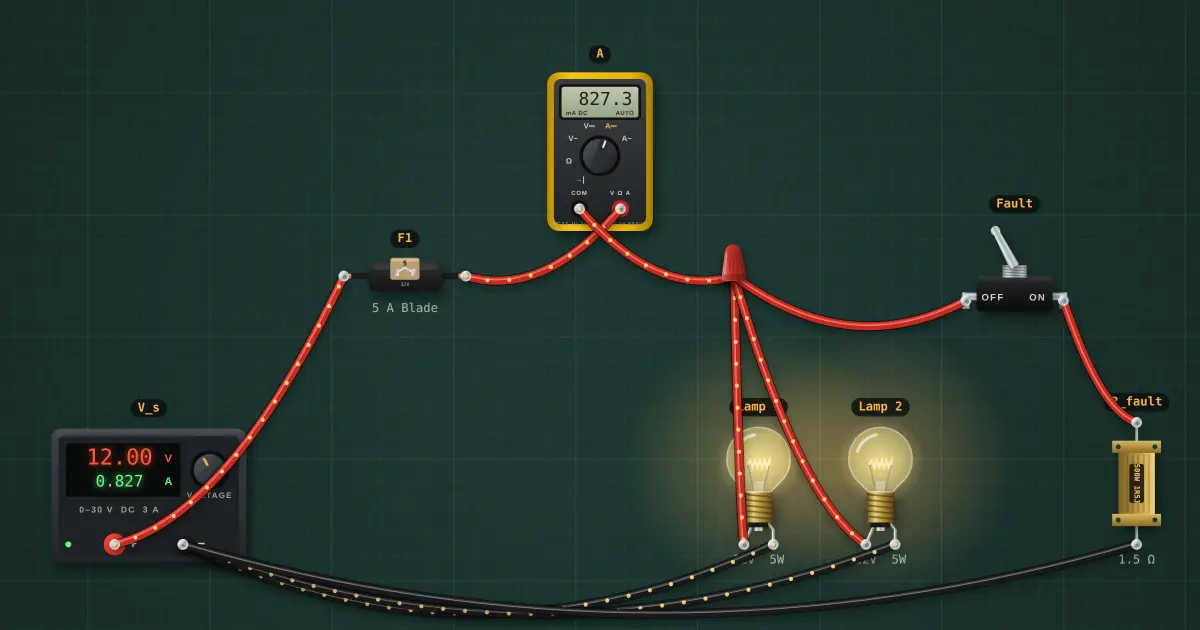
Open this lesson in the labFree, in your browser, no account needed.
How it works
Normal load: two 5 W lamps, I = 12 V / 14.4 Ω ≈ 833.3 mA, 17 % of the 5 A fuse.
Fault (a 1.5 Ω short-ish path): I ≈ 12 / 1.36 Ω = 8.228 A, 1.6× the rating.
Blade fuses survive 110 % for hours, 200 % for about a second, and 500 % for a few milliseconds: the time falls roughly as 1/I⁴. Pick the fuse at about 1.25–1.5× the normal current, and never above what the wire can carry.
Try it on the bench
- Flip the Fault switch: about 8.5 A flows and the 5 A fuse opens in about two seconds.
- Replace the fuse, set it to 10 A and try again: now it would carry the fault for many seconds while the wiring heats. Fuses must match the circuit.
- Change R_fault to 0.2 Ω for a hard short: it blows almost instantly.
Parts on the bench
- Bench power supply
- Fuse
- Digital multimeter
- 2 × Incandescent bulb
- Toggle switch
- Resistor
In the course
Zen’s Electronics Design Mastery, module “DC Fundamentals”.