Ohm’s law
Voltage pushes, resistance resists, and current is the result: I = V / R. Double the voltage across a resistor and the current doubles. The ratio V / I stays fixed at R, so its V–I graph is a straight line.
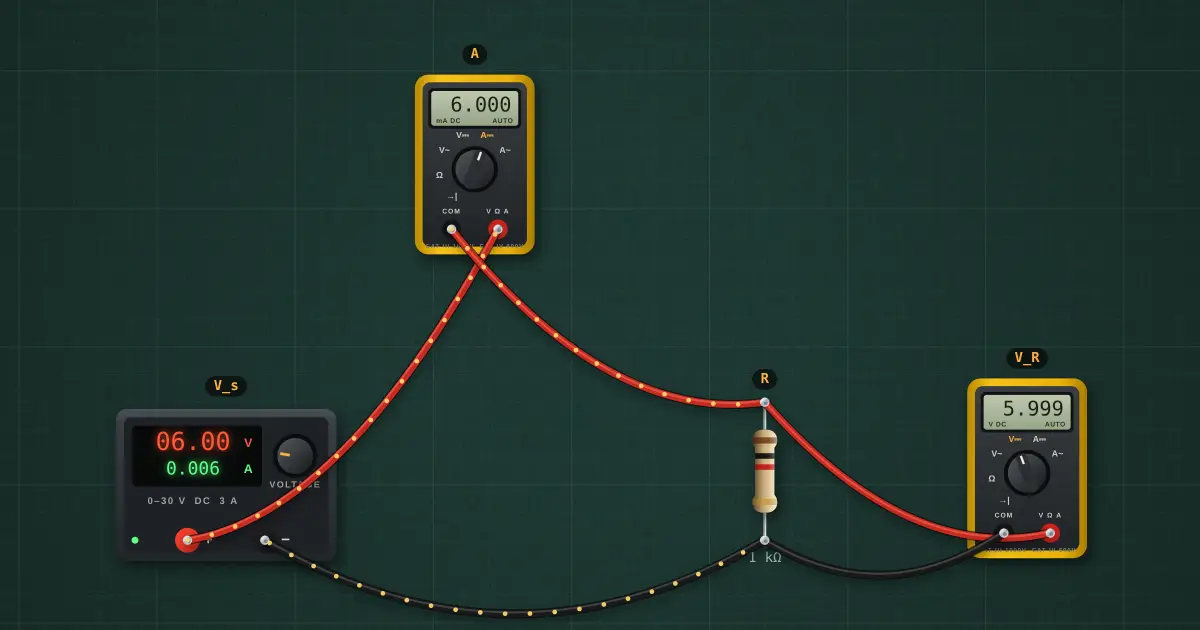
Open this lesson in the labFree, in your browser, no account needed.
How it works
I = V / R = 6 V / 1 kΩ = 6 mA
Rearranged: R = V / I and V = I · R. Cover the one you want in the triangle V over I × R.
00 A35 mA610 mA915 mA1220 mAVoltage across R (V)CurrentOrange line: theory. Green dots: what you have measured so far.
Slope of the line = 1 / R = 1 mS (siemens).
Try it on the bench
- Select the supply and set 2, 4, 6, 8, 10 and 12 V. Each one adds a green dot, and they all land on the line.
- Change R to 470 Ω: the line gets steeper because the same voltage now pushes more current.
- Every meter reading obeys V = I · R. Check it with a calculator.
- Switch on Tools… → Operating-point overlay: every node voltage and every wire current appears on the mat at once.
Parts on the bench
- Bench power supply
- 2 × Digital multimeter
- Resistor
In the course
Zen’s Electronics Design Mastery, module “DC Fundamentals”.