Power and power ratings
Power is how fast energy is used: P = V · I, which also equals I² · R and V² / R. A resistor turns all of it into heat, so it needs a power rating with headroom. A lamp turns some of it into light.
Open this lesson in the labFree, in your browser, no account needed.
How it works
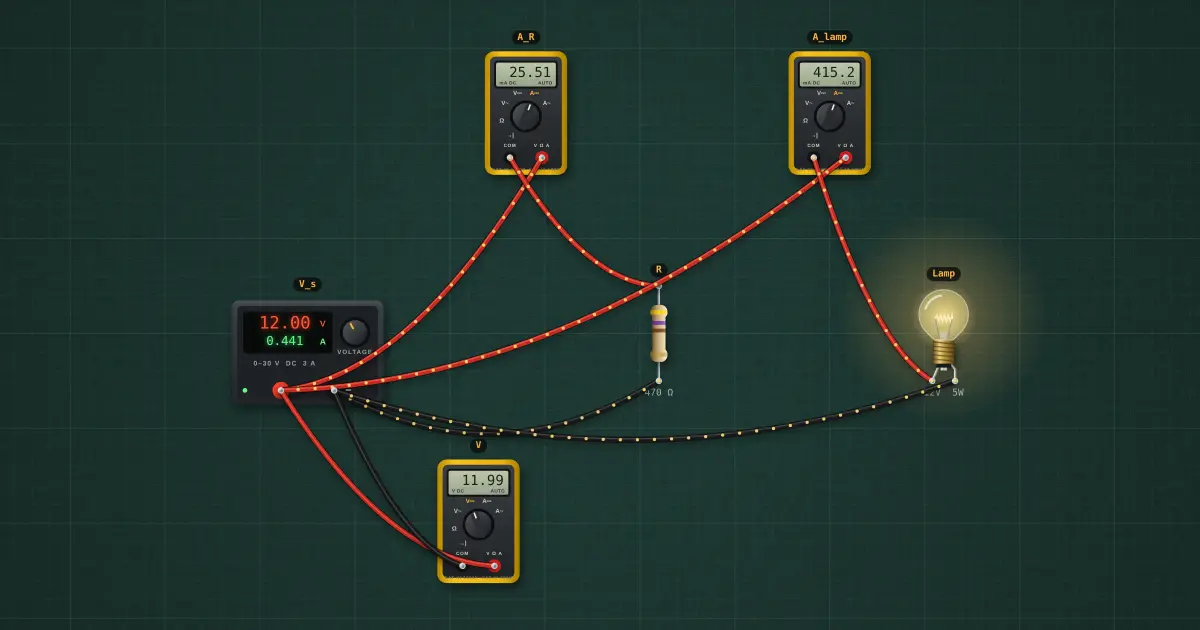
Resistor: P = V² / R = 12 V² / 470 Ω = 306 mW, which is 61 % of its 0.5 W rating. Aim for under about 50–60 % so it runs cool.
Lamp (28.8 Ω hot): P = V² / R = 5 W, I = P / V = 416.7 mA
Energy = power × time. In one hour the bench uses 5.31 Wh.
Try it on the bench
- Change R to 100 Ω: 1.44 W in a ½ W resistor. It glows, then burns out. Undo, set it to 100 Ω again, and pick a 2 W resistor instead.
- Lower the supply to 6 V. The power falls to a quarter, because P goes as V².
Parts on the bench
- Bench power supply
- 3 × Digital multimeter
- Resistor
- Incandescent bulb
In the course
Zen’s Electronics Design Mastery, module “DC Fundamentals”.