Load-cell scale front end
Four strain gauges on a metal bar form a Wheatstone bridge whose output is a millivolt or two at full load. The HX711 excites the bridge, amplifies the difference 128 times and converts it to 24 bits; the ESP32 removes the offset (tare) and scales the counts to grams.
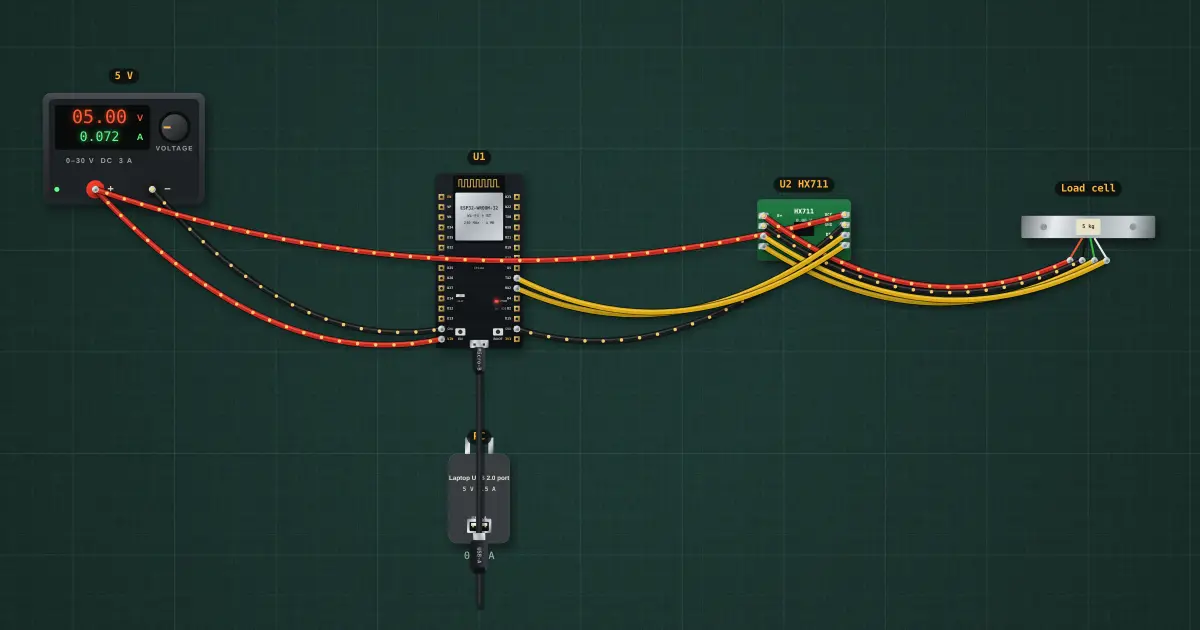
Open this lesson in the labFree, in your browser, no account needed.
How it works
Full scale (5 kg) gives 1 mV per volt of excitation: about 4.3 mV at 4.3 V, 860 nV per gram.
The HX711 maps ±0.5·E/128 to ±2²³ counts, so one gram is 429.5 counts: that is the set_scale() factor in the sketch.
Try it on the bench
- Put 2.5 kg on the cell (select it).
- Change set_scale() to a wrong number and see why every scale needs calibrating with a known weight.
Parts on the bench
- Bench power supply
- ESP32 DevKit
- USB charger / port
- HX711 load-cell ADC
- Load cell
In the course
Embedded & IoT, module “Buses and sensors”.