4. Diode: reverse-polarity protection
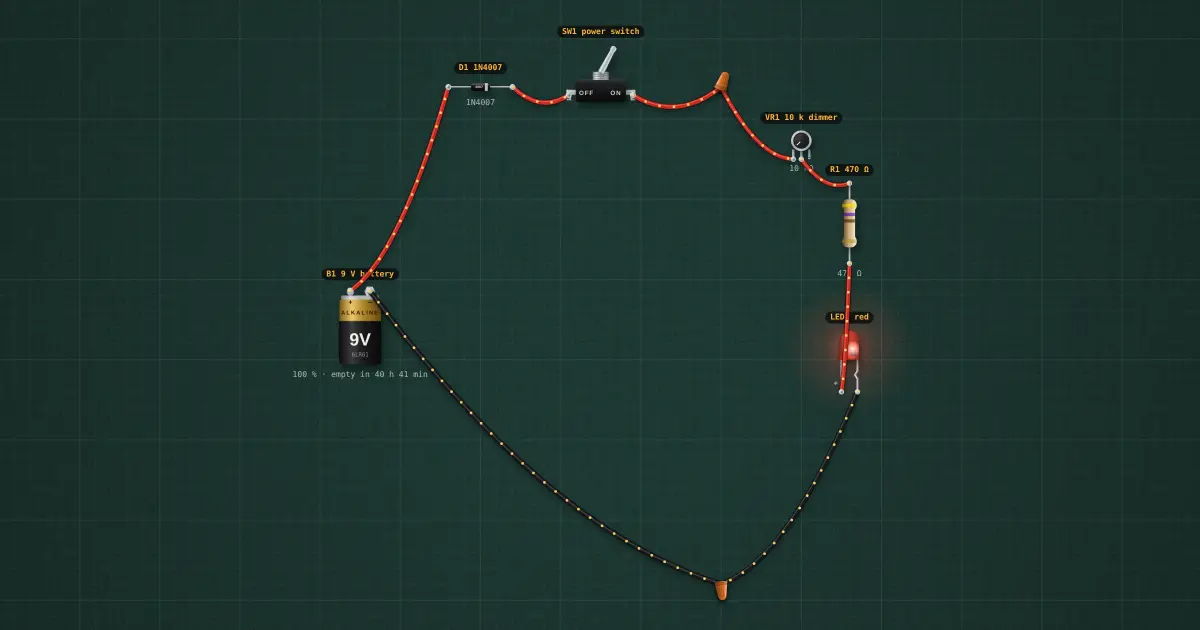
Step 4 of the automatic light: D1 in the + line right after the battery. The LED gets 0.7 V less (a little dimmer); connect B1 backwards and the circuit simply stays dark, no damage. Component 4 of 14: the diode. A diode conducts one way only (anode → cathode) and drops about 0.7 V while doing it. In reverse it blocks, up to its peak reverse voltage. The cheapest protection there is: if the battery goes in backwards, nothing flows.
Build it in the labGuided build, test sheet and fault finding, free in your browser.
Parts list
Test procedure
Each test has an expected value and a pass range, like a factory test sheet:
- Normal: LED lit (0.7 V less)
- Battery connected backwards
How it works
The diode. A diode conducts one way only (anode → cathode) and drops about 0.7 V while doing it. In reverse it blocks, up to its peak reverse voltage. The cheapest protection there is: if the battery goes in backwards, nothing flows.
Reading it. The band marks the cathode. 1N4007: 1 A, 1000 V. 1N4148: small signal, 0.2 A, 100 V. Schottky (1N5819): only ~0.3 V drop, but less reverse voltage.
Testing it. Meter on the diode range: 0.5–0.7 V with red on the anode, OL the other way. OL both ways = open; 0 both ways = shorted.
In the build. D1 in the + line right after the battery. The LED gets 0.7 V less (a little dimmer); connect B1 backwards and the circuit simply stays dark, no damage.
Builds on lesson 3: everything from before is still there.
Next: lesson 5, capacitor.
Things to try
- Measure the voltage across D1 while the LED is lit: about 0.7 V.
- Swap D1 round (it then blocks the right way): the LED stays dark. That is what it does for a reversed battery.
Background
One circuit, built up one part at a time: by lesson 14 it is a solar-powered, dusk-sensing, motion-triggered timed lamp with an alarm.