Basic transformer
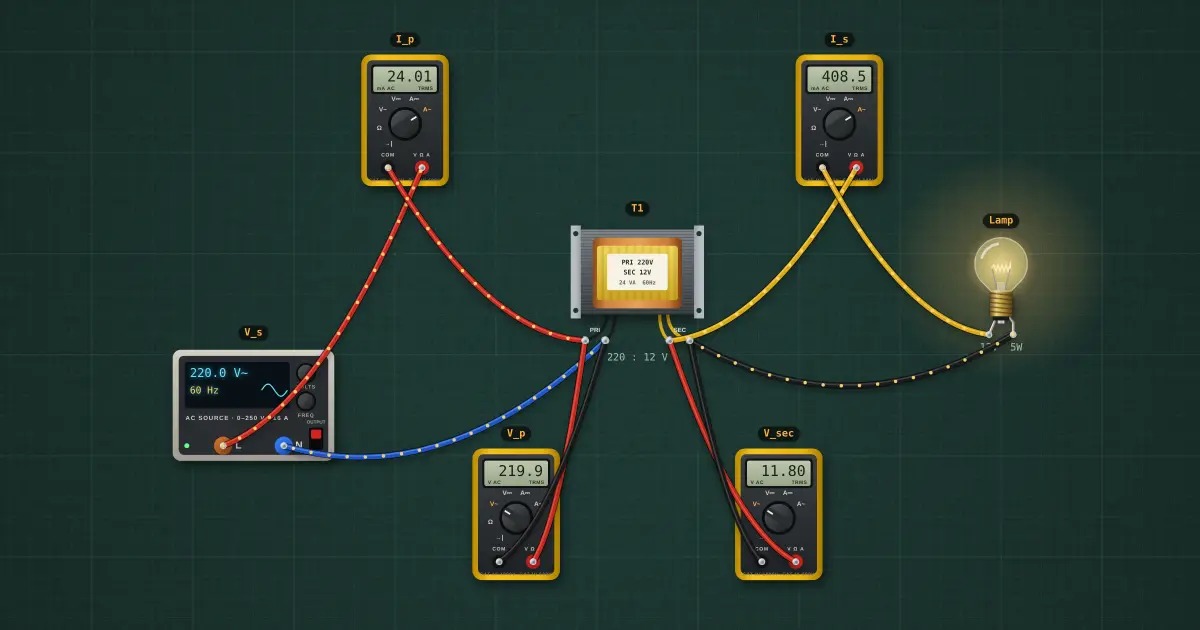
Two windings on one iron core. The voltage scales with the turns ratio and the current scales inversely, so the power in roughly equals the power out. It only works on AC.
Open this lesson in the labFree, in your browser, no account needed.
How it works
Turns ratio a = Np/Ns = Vp/Vs = 220/12 = 18.33
Vs = Vp / a = 12 V (ideal; real windings sag a few % under load)
Ip = Is / a, so VpIp ≈ VsIs.
The primary also draws a magnetising current Im (about 8 % of its rated current here) to keep the core flux going. It is 90° out of phase with the load current, so it adds as a right triangle. The windings’ resistance makes Vs sag about 8 % at full load.
Try it on the bench
- Select T1 and pick other secondary voltages (6, 24, 110 V). Swap the lamp to match.
- Feed the primary from the bench DC supply at 30 V instead. Nothing appears on the secondary, the core saturates, and the primary overheats within seconds.
Parts on the bench
- AC source
- 4 × Digital multimeter
- Transformer
- Incandescent bulb
In the course
Zen’s Electronics Design Mastery, module “Diodes & Power Supplies”.