Series-pass regulator (transistor + Zener)
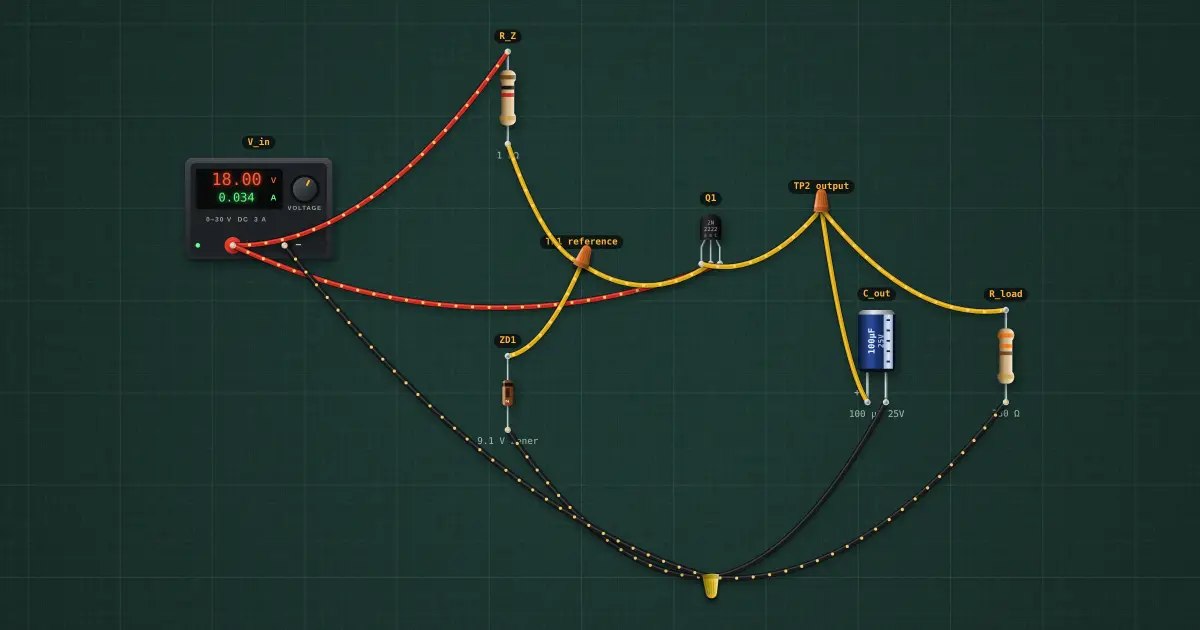
A Zener diode makes a steady reference, but it cannot supply much current. An emitter follower copies that reference to the output with current gain β, so the output is V_Z − V_BE and the transistor carries the load current.
Open this lesson in the labFree, in your browser, no account needed.
How it works
V_out = V_Z − V_BE ≈ 9.1 − 0.7 = 8.40 V.
The Zener only supplies the base current (I_load ÷ β), so it holds its voltage while the transistor delivers 25.5 mA to the load.
Try it on the bench
- Set V_in to 15 V, then 22 V: compare how much the output moves with how much the input moved.
- Short the output (R_load → 10 Ω): the transistor overheats. Real designs add a current-limit transistor.
Parts on the bench
- Bench power supply
- 2 × Resistor
- Zener diode
- NPN transistor
- Electrolytic capacitor
In the course
Electronics Technician, module “Power supplies”.