Three-phase delta (Δ)
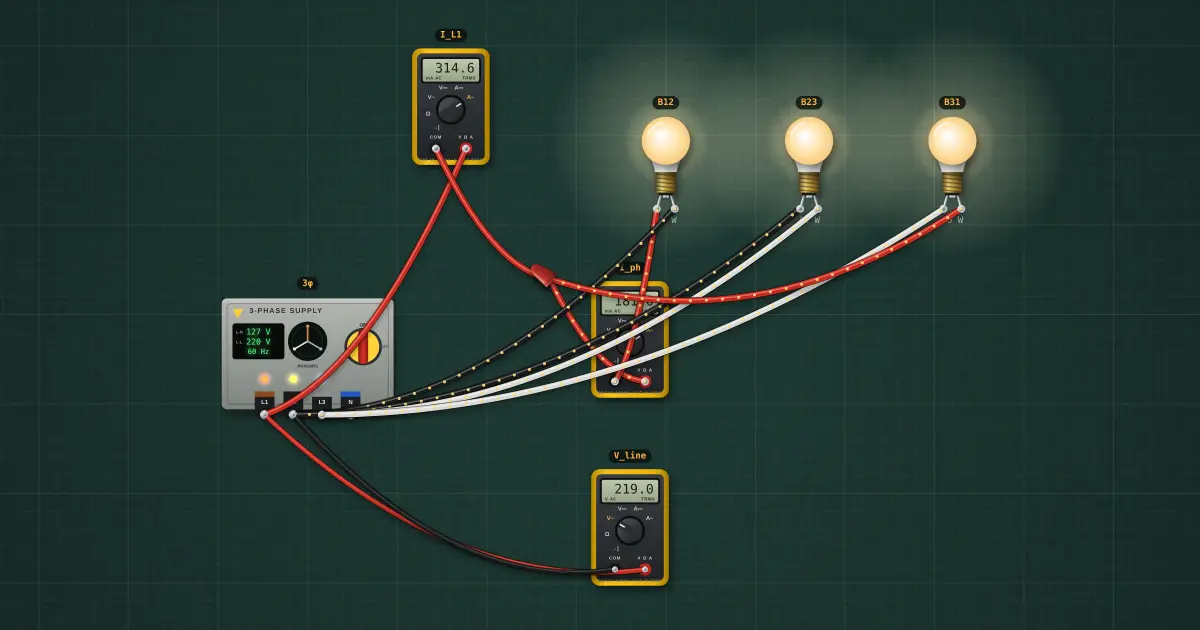
In a delta each load sits directly between two lines, so it sees the full line voltage. Each line current is the phasor difference of two load currents, √3 times a load current when balanced.
Open this lesson in the labFree, in your browser, no account needed.
How it works
In a delta, Vload = Vline = 220 V
Iphase = Vline / Rlamp = 181.8 mA
Iline = I12 − I31 (phasors) = √3 · Iphase = 314.9 mA when balanced. P = 3 · VL · Iph = 120 W
Try it on the bench
- Switch the supply to 230/400 V. The 240 V lamps now get 400 V each and blow. A delta load must be rated for the line voltage.
- Change one lamp’s wattage and see I_line / I_phase move away from 1.732.
Parts on the bench
- Three-phase supply
- 3 × Digital multimeter
- 3 × 220 V bulb
In the course
Zen’s Electronics Design Mastery, module “AC & Reactance”.