Linear supply: transformer, bridge, capacitor, regulator
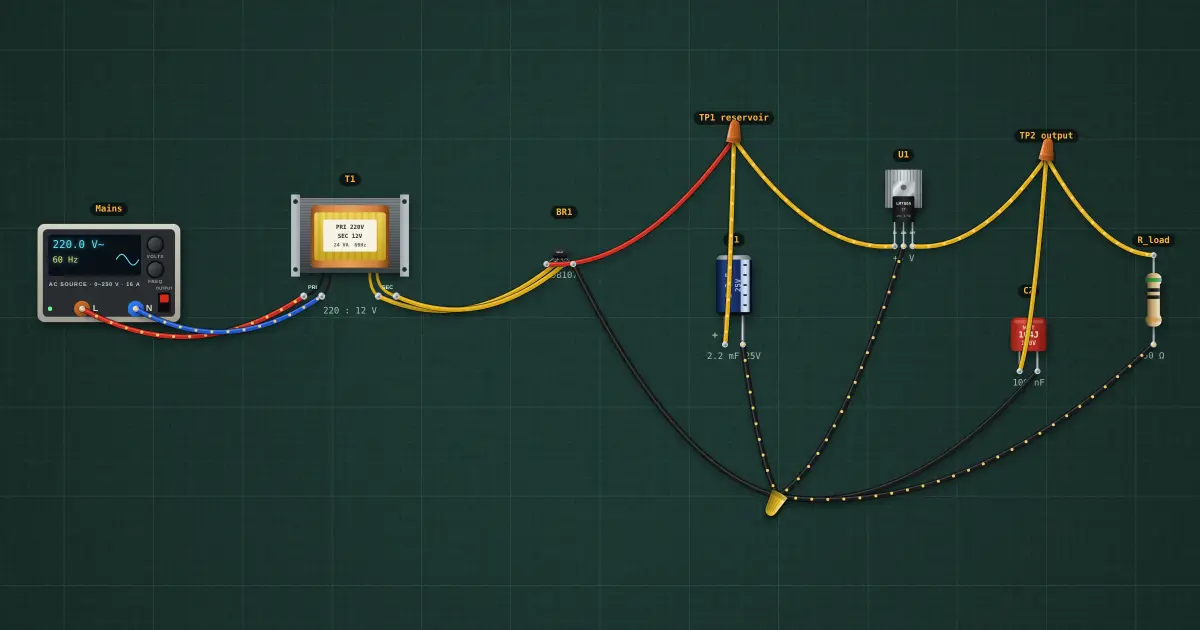
The four blocks of every mains supply before switch-mode: a transformer steps 220 V down and isolates it, a bridge rectifies both half-cycles, a reservoir capacitor fills the gaps (leaving a sawtooth ripple), and a regulator irons the ripple out into a flat 5 V.
Open this lesson in the labFree, in your browser, no account needed.
How it works
Load 105 mA; the capacitor is topped up every 1/120 s, so the ripple is
ΔV ≈ I ÷ (2·f·C) = 398 mV peak-to-peak.
That is an upper bound: it assumes the capacitor discharges for the whole half-cycle. The transformer’s winding resistance makes the diodes conduct for a millisecond or more each time, so the bench ripple comes out 10–20 % lower.
The 7805 needs its input to stay about 2 V above 5 V even at the bottom of the ripple.
Try it on the bench
- Change C1 to 470 µF: the ripple quadruples, and at full load the regulator starts to drop out.
- Change R_load to 10 Ω (0.5 A): watch the regulator’s temperature climb.
Parts on the bench
In the course
Electronics Technician, module “Power supplies”.