12 V → 5 V regulators
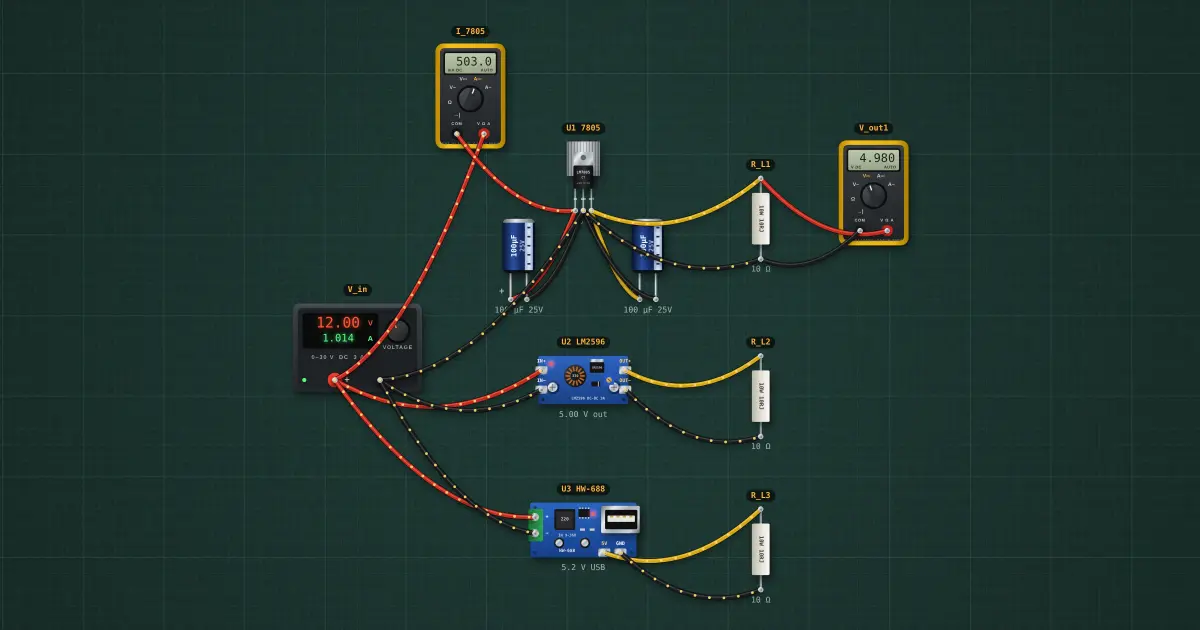
Three ways to make 5 V from 12 V, each driving the same 10 Ω load. A linear 7805 burns the difference as heat, so its efficiency can never beat V_out / V_in. The switching bucks (LM2596, HW-688) stay above 80 %.
Open this lesson in the labFree, in your browser, no account needed.
How it works
7805: Iin ≈ Iout = 5 V / 10 Ω = 500 mA, so Pheat = (Vin − 5 V) · I = 3.5 W and η ≈ 5/12 = 41.7 %
Junction temperature ≈ 25 °C + P · θJA = 25 + 3.5 W × 12 °C/W = 67 °C (shuts down at 150 °C). It needs about 2 V of headroom, so Vin ≥ 7 V.
Bucks: Pin = Pout / 0.86 + 60 mW of controller overhead, so the input current is well below the output current.
Try it on the bench
- Select the 7805 and take it off its heatsink. Watch the junction climb to 150 °C, shut down and cycle.
- Raise V_in to 24 V. The 7805 heat more than doubles, while the bucks barely notice.
- Lower V_in to 6 V. The 7805 drops out below 5 V, and the HW-688 stops under 7 V.
Parts on the bench
- Bench power supply
- 2 × Digital multimeter
- 7805 regulator
- 2 × Electrolytic capacitor
- 3 × Resistor
- Step-down converter
- USB step-down module
In the course
Zen’s Electronics Design Mastery, module “Diodes & Power Supplies”.