Three-phase star (Y)
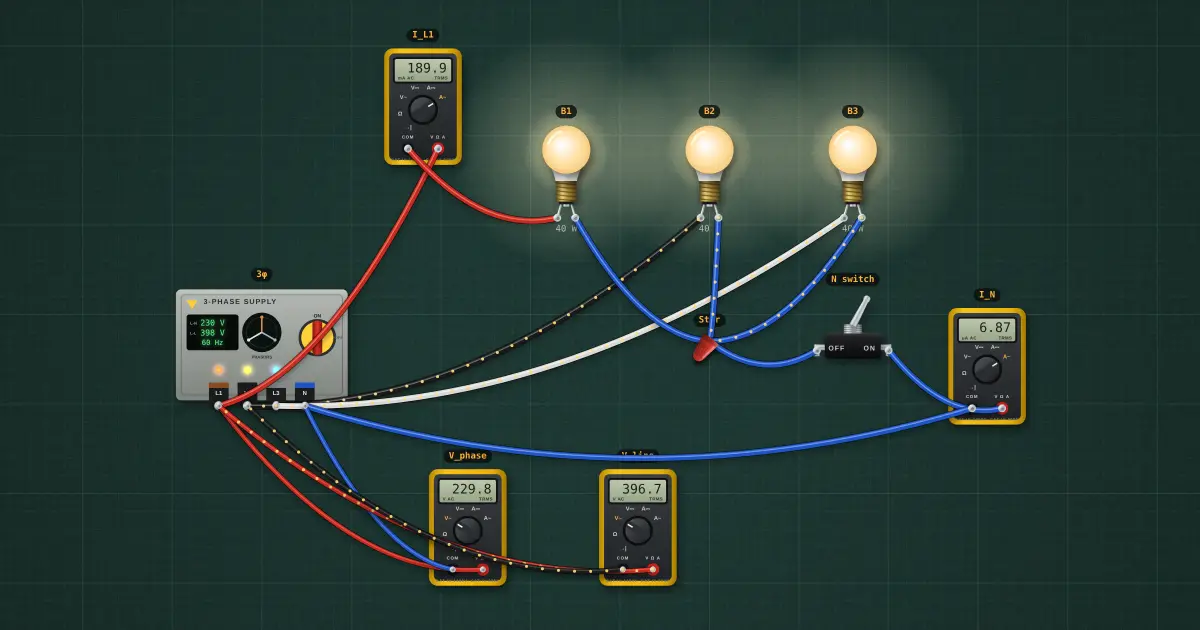
Three loads share a common star point tied to neutral. Each sees the phase voltage, the line voltage between phases is √3 larger, and a balanced load sends no current back on the neutral.
Open this lesson in the labFree, in your browser, no account needed.
How it works
Vline = √3 · Vphase = 1.732 × 230 V = 398.4 V
In a star, Iline = Iphase = Vphase / Rlamp. The three phase currents are 120° apart, so when they are equal they sum to zero on the neutral.
Ptotal = 3 · Vph · Iph = √3 · VL · IL = 131 W (balanced).
Try it on the bench
- Change B2 to a 9 W lamp. The load is now unbalanced and current appears on the neutral.
- With the load unbalanced, open the N switch. The star point floats: the light lamp is over-volted (and may blow) while the others starve. This is why a neutral must never be fused or broken.
Parts on the bench
- Three-phase supply
- 4 × Digital multimeter
- 3 × 220 V bulb
- Toggle switch
In the course
Zen’s Electronics Design Mastery, module “AC & Reactance”.