Synchronous counter (74HC161)
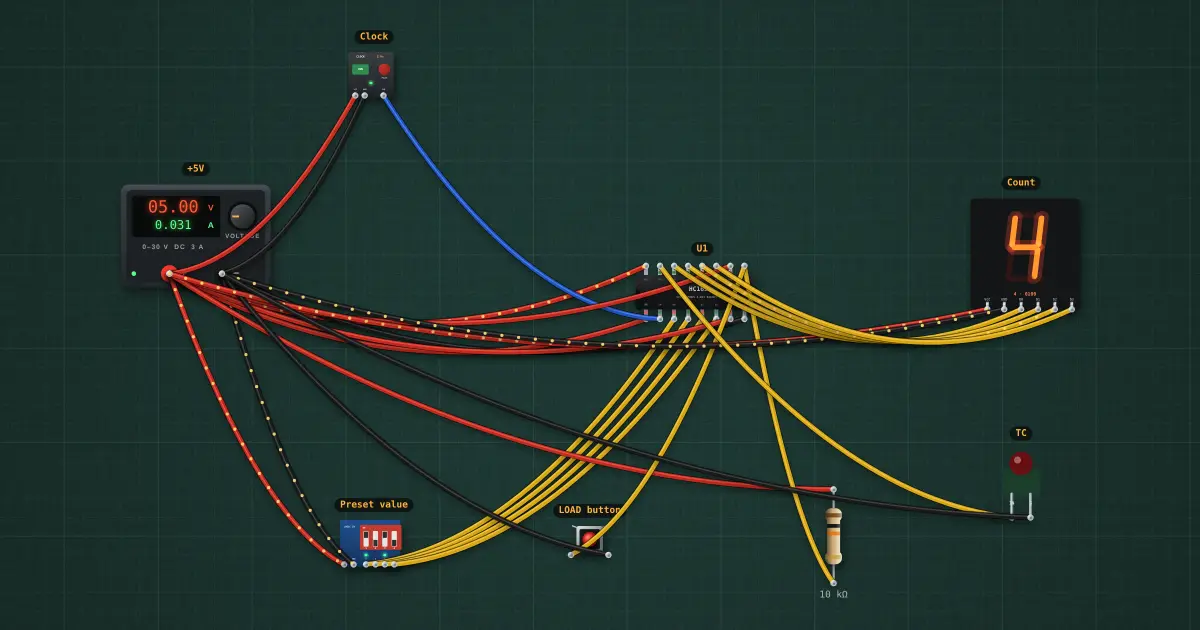
In a synchronous counter every flip-flop shares one clock, and gates decide which bits toggle. All the bits change at the same instant: no ripple, no glitches. TC goes high at 15 so counters can be chained.
Open this lesson in the labFree, in your browser, no account needed.
How it works
On each rising edge: if PE̅ = 0, load D3–D0; else if CEP = CET = 1, count up. TC = CET · (Q = 1111).
Recent counts: —
Try it on the bench
- Hold the LOAD button through a clock edge: the counter jumps to the preset (5 here, from switches 1 and 3).
- Watch TC light for one count at F. Feed TC into a second counter’s CET to count to 255.
- Make a decade (0–9) counter: preset 0 and load whenever the count reaches 9, using a NAND gate on Q3 and Q0.
Parts on the bench
- Bench power supply
- Clock / pulse generator
- DIP switch module
- 74xx161
- Hex display (decoded)
- Logic indicator LED
- Push button
- Resistor
In the course
Zen’s Electronics Design Mastery, module “Digital Electronics”.