Capacitors in series and parallel
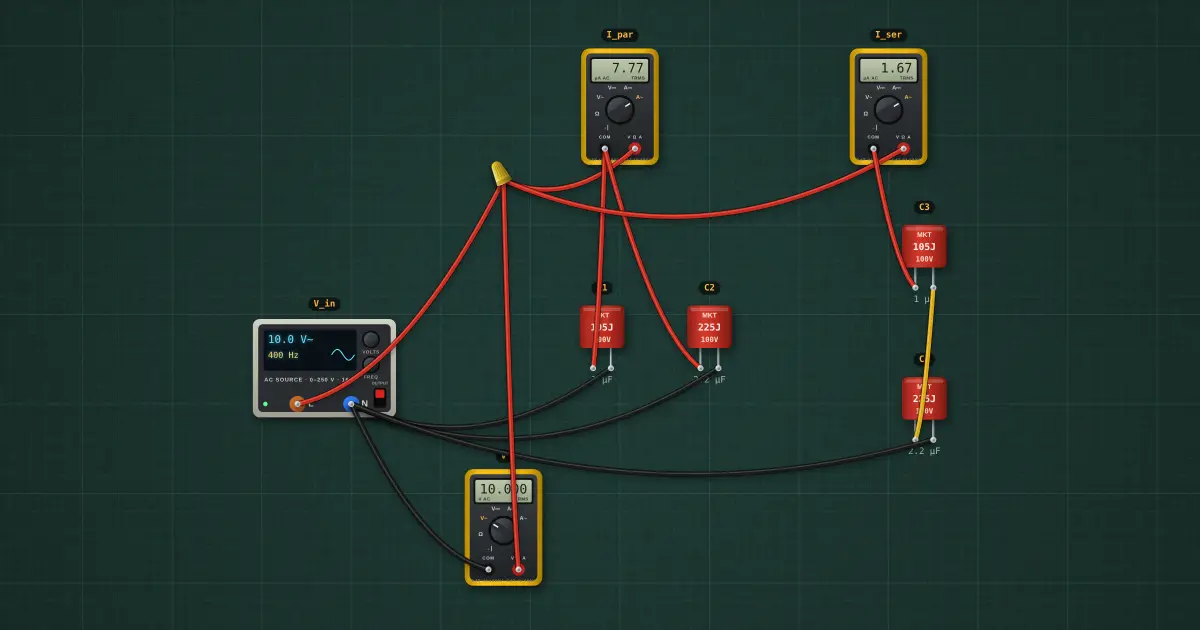
Capacitors combine the opposite way to resistors. In parallel their plate areas add, so C = C1 + C2. In series it is like thicker insulation, so 1/C = 1/C1 + 1/C2 and the total is smaller than either. The AC current shows the result: I = 2πf·C·V.
Open this lesson in the labFree, in your browser, no account needed.
How it works
Parallel: C = C1 + C2 = 1 µF + 2.2 µF = 3.2 µF
Series: C = C3·C4 / (C3 + C4) = 687 nF, smaller than the smallest one.
At 400 Hz: I = 2πf·C·V → 80.42 mA into the parallel pair, 17.28 mA into the series pair. The table works backwards from the meters: C = I / (2πf·V).
In series both capacitors carry the same charge, so the smaller one takes the larger share of the voltage: V3/V4 = C4/C3.
Try it on the bench
- Make all four 1 µF: the parallel pair is 2 µF and the series pair 0.5 µF, a 4:1 ratio in current.
- Double the frequency: both currents double, but the capacitances worked out from them stay the same.
Parts on the bench
- AC source
- 3 × Digital multimeter
- 4 × Film capacitor
In the course
Zen’s Electronics Design Mastery, module “Capacitors, Inductors & Time”.