Reactance of L and C
On AC, inductors and capacitors limit current through reactance. X_L = 2πfL grows with frequency, so a coil passes low frequencies. X_C = 1/(2πfC) shrinks with frequency, so a capacitor passes high frequencies and blocks DC.
Open this lesson in the labFree, in your browser, no account needed.
How it works
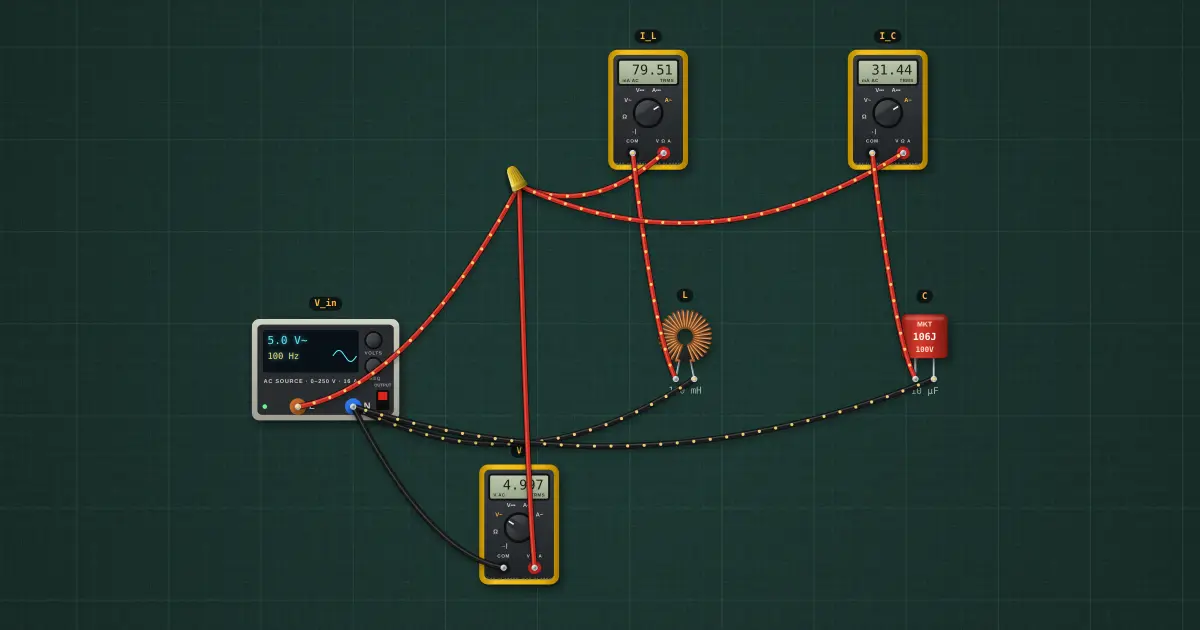
At 100 Hz: XL = 2π·f·L = 62.8 Ω (plus 1.5 Ω of winding), XC = 1/(2π·f·C) = 159 Ω
IL = V / |ZL| = 79.54 mA, IC = V / XC = 31.41 mA
They are equal at f = 1/(2π√LC) = 159.2 Hz. Below that the coil carries more; above it the capacitor does.
Try it on the bench
- Set the source to 50 Hz, then 200 Hz. I_L halves each time the frequency doubles, and I_C doubles.
- Try 1 Hz: the capacitor passes almost nothing, while the coil is limited only by its winding resistance.
Parts on the bench
- AC source
- 3 × Digital multimeter
- Toroidal inductor
- Film capacitor
In the course
Zen’s Electronics Design Mastery, module “AC & Reactance”.