Peak, peak-to-peak and RMS
An AC voltage swings between +V_pk and −V_pk. Its RMS value is the DC voltage that would heat a resistor equally: for a sine, V_rms = V_pk / √2. Mains “220 V” is an RMS value; its peaks reach 311 V.
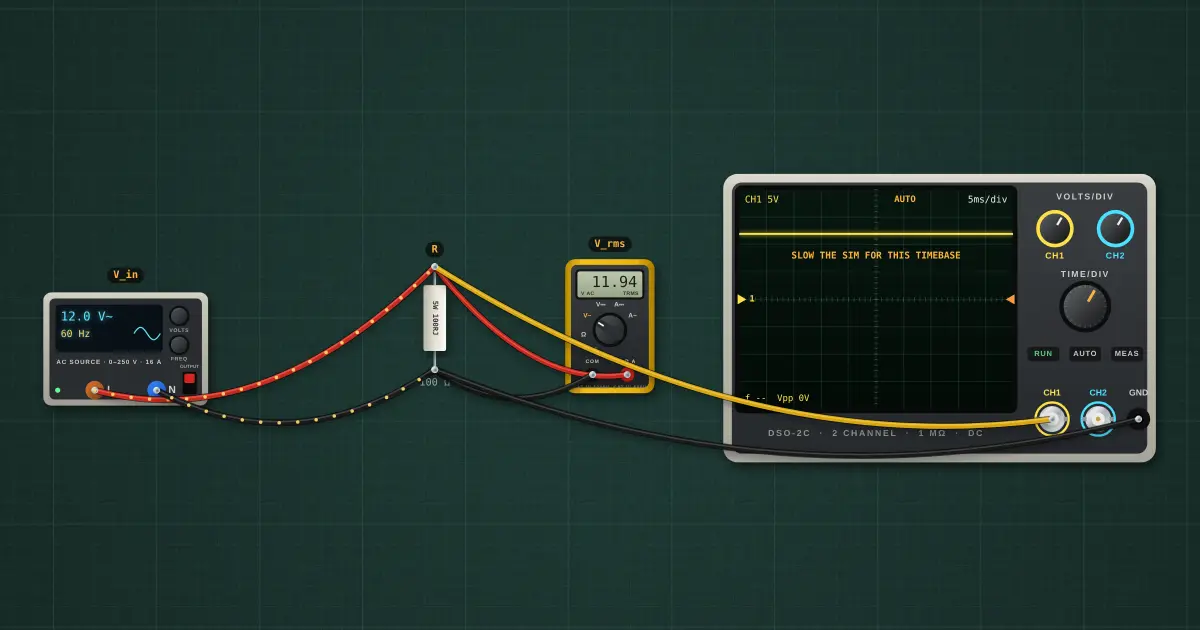
Open this lesson in the labFree, in your browser, no account needed.
How it works
Crest factor for a sine: V_pk = √2 · V_rms
Vpk = 1.414 × 11.94 V = 16.89 V, Vpp = 2·Vpk = 33.77 V
P = Vrms² / R = 1.43 W, the same heat as 11.94 V DC.
The average over a whole cycle is 0 V, so a DC meter would read nothing useful. That is why AC is quoted in RMS.
Try it on the bench
- Select the AC source and switch the wave to square: now the peak equals the RMS value.
- Try triangle: the peak is √3 = 1.73× the RMS value.
- Set 220 V and a 2.2 kΩ 50 W resistor to see the 311 V mains peaks.
Parts on the bench
- AC source
- Resistor
- Digital multimeter
- Oscilloscope
In the course
Zen’s Electronics Design Mastery, module “AC & Reactance”.