Difference amplifier
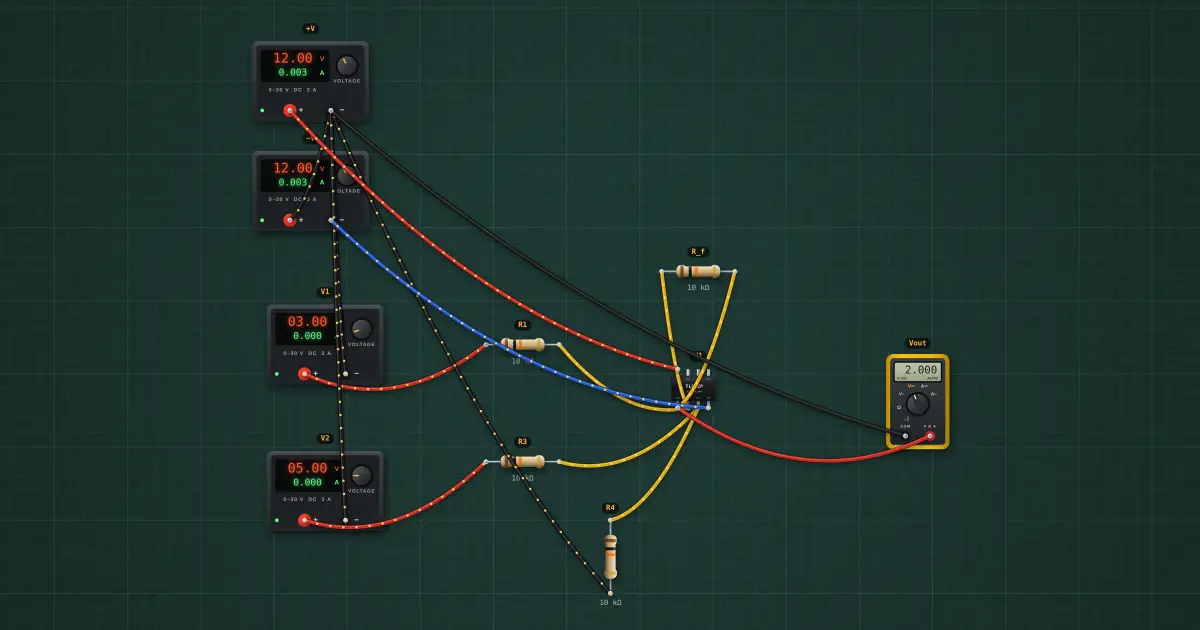
Feed one signal to each input through matched resistors and the op-amp amplifies only their difference: V_out = (R_f / R1) · (V2 − V1). Anything common to both (noise, an offset) cancels.
Open this lesson in the labFree, in your browser, no account needed.
How it works
With R_f/R1 = R4/R3 = 1.00:
Vout = 1.00 × (5 − 3) = 2 V
Try it on the bench
- Raise both V1 and V2 by 2 V: the output does not move (common-mode rejection).
- Set R_f and R4 to 47 kΩ for a gain of 4.7.
- Unbalance it by changing only R4: now part of the common voltage leaks through.
Parts on the bench
In the course
Zen’s Electronics Design Mastery, module “Op-Amps & Analog ICs”.